PN&T 1 — Film Cameras
Photography Now & Then
(PN&T) is a personal journey about cameras, lenses, films and digital imaging I have used since 1980
(When citing this article, please use photonat.4020.net
)
| Topic | Description |
|---|---|
| Early Cameras | Film cameras used during high school and university |
| Rolleiflex T | Medium format 6×6 fixed lens TLR |
| Mamiya RB67 Pro–S | Medium format 6×7 “Texas Hasselblad” |
| Mamiya C330 Professional | Medium format 6×6 TLR with interchangeable lenses |
| Hasselblad V Series | Medium format 6×6 501CM, 500EL/M & Flexbody |
| 135 cameras | 35mm film cameras: Leica R9, Nikon F3/T, Nikon F5, Leica IIIG & Leica M6 TTL |
| Stories | Rolleiflex T sale • Alfa Romeo badge |
 Proudly and defiantly, no AI was used to create this article
Introduction
I was never a full–time professional photographer nor even trained as one.
Instead I always had regular employment in areas unrelated to photography. Yet have also done dozens of professional photo–shoots, either one–off commissions or repeat work for clients as varied as Bausch + Lomb, Spike Wireless, Sydney Morning Herald, Warner Bros Theatrical, Hewlett Packard, Lion Nathan Brewers, University of Wollongong, GM Holden Australia, The Australian War Memorial, Brett Whiteley Stuidos and The Australian National Maritime Museum.
In 2024–25 I wrote two monographs on photoshoots I did during 1980–91, to accompany high resolution rescans of the original films. While my notes primarily focused on the photographs and individuals involved, I became increasingly fascinated by the techniques and technical aspects of the work. In particular, I was intrigued by the extent to which photography has (and has not) evolved since the 1980s. Clearly it was time to write a more detailed essay.
What follows was originally intended for the “Notes” section of my The Boomer Legacy photography project. When it grew beyond 20K words, I realised it better belonged here.
All the equipment I use has been purchased and paid for by myself. No loaners for positive reviews. No grants, awards, offers, scholarships, bursaries, gifts, affiliate links or handouts from distributors/ departments/ councils/ partners or multi–millionaire racehorse owning Fathers in Law.
90% of the following is unashamedly about photographic equipment. Hardware. The metal that meets the meat. No bearing witness
nor sweeping tapestry of lingering unregeneratively in Plato’s cave
. No SHOCKING SECRETS & LIES EXPOSED!
clickbait. Absolutely no Artspeak. Nor do I indulge in the photographer’s cliché of lauding my own gear while disparaging everyone else’s. Indeed some of my most used cameras I can barely tolerate until upgrading to something better. I even poke fun at some of my gear because… why not?
Consider the following a guided tour of the mostly 2nd hand equipment I have owned and used over the last 45 years. Sometimes I explore tangents to address broader issues, or recount stories, or give obscure advice, or even dwell on the kind of technical minutiae which would make a nerd’s head spin. It’s all part of the fun and, what the hell, it’s my website and there is no Ben Bradlee barking down the phone.
Overview
Photography Now & Then
was originally a single article, but has since been split into three sections:
- Part 1 — Film cameras
- [ link ] Nikon & Leica 35mm cameras, Hasselblad & Mamiya 120 medium format
- Part 2 — Film, Filters & Accessories
- [ link ] B&W negative, colour transparency and negatives; Film processing; Lens filters; Handheld lightmeters; Flash & continuous lighting
- Part 3 — Digital Cameras & Photography
- [ link ] Sony & Leica mirrorless cameras; Digital workflow, issues, impact of A.I.; The importance of your own website
Student Cameras
We all have to start somewhere…
Nearly all the cameras in this section, which I used as a student in the Eighties, are fully mechanical and manual exposure. At that time, auto–exposure with film was unreliable as you only discovered too late if settings were incorrect. While a sequence of ±EV bracketed frames could be taken for insurance, it was an extravagant waste of film, particularly for 120 medium format where each frame cost $s.
Due to the “analogue resurgence” since the 2010s, a lot of the following has become popular again, especially among younger photographers. Hence the detailed discussions below.
Section Quick Links
- Minolta SRT–101
- Nikon F2 Photomic
- Polaroid OneStep 600
- Nikon F
- Nikon F4S
- Rollei 35S
- Rolleiflex T (M2)
- Mamiya RB67 Pro–S
- Fujifilm GW670III Professional
Minolta SRT–101 (1980) ↑
I purchased my first 35mm film camera in 1980 when I was sixteen: a well–used Minolta SRT–101 with a Rokkor 50mm ƒ1.7 lens. Fully manual and mechanical, the “101” still gets a lot of love online, even though I never felt it: see this 2024 Reddit thread. There was nothing particularly wrong with it, I just found the results uninspiring.
I mainly got it to bask in the glory of all the print ads in early 1970s National Geographic Magazines. It was an adequate albeit boxy camera, the CLC metering was reasonably accurate (for reflected readings) and the 50/1.7 lens was fine. But I always felt I could do better, so sold it within a year. Almost 20 years later I was surprised to see a “101” pop up again as Rose Byrne’s retro camera in the Aussie crime film Two Hands (1999)
(!?)
Nikon F2 (1981–6) ↑
I spent my final year at high school in 1981 working two after–school jobs to save for my first proper camera: a 1972 silver chrome Nikon F2 Photomic. Got it 2nd hand from a retired accountant for $AUD 490, which in 2025 works out to $2420.
It had a DP–1 Photomic viewfinder, which I often swapped with a DW-1 waist level finder for candid shots. In all aspects it was a vast improvement over the SRT-101, although six months later I dropped it onto concrete and broke the body shell around the lens mount (!) Irreparable damage, despair & disbelief. Took it to a few camera technicians to see what they could do, but they all shook their heads. One of them even laughed. I used epoxy glue to mend it as best as I could, but a few years later sold it for spare parts 😢
Meanwhile I used it without too much trouble. Only the body shell alongside the lens–mount had fractured, everything else — shutter, mirror mechanism, viewfinder, lens mount, camera back, film transport etc. — all worked fine. The epoxied mount ended up being as strong as ever, although the lens axis was now tilted ≈0.25° away from perpendicular. Most of the time this had no effect, but at wider apertures it resulted in the frame RHS being subtly close–focused. I worked around it by mostly photographing things at an angle to bring the RHS a bit closer to the camera. It even proved beneficial for portraiture as it acted like a lens tilt which, in vertical format, brought the lower part of the sitter into better focus.
A couple of decades later I purchased a 1982 black chrome Nikon F2A with DP–11 finder. By then I was using a Leica R6.2 and deep in Leica Land, so feelings were more muted. Indeed I was unsentimental enough to have the F2A butchered modified by a NYC camera technician so it could work with Leica R lenses; see my Leica FAQ.
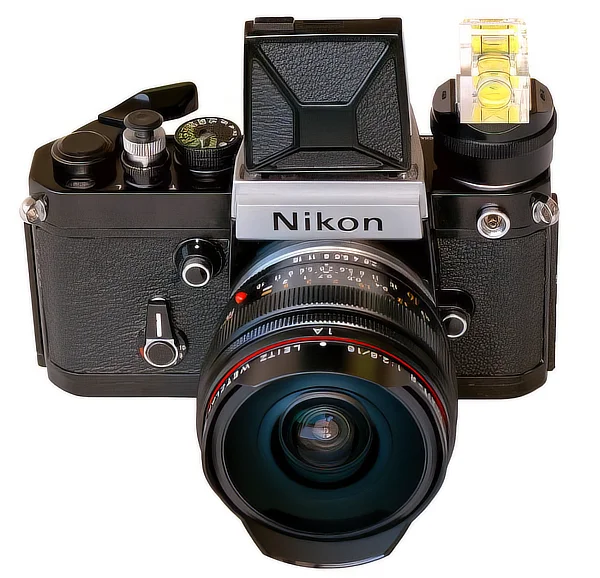
Nikon F2 merits? Fully mechanical & battery independent operation, aside from the 3V CR1/3N battery to power the lightmeter in the photomic finder. A large selection of interchangeable finder options and focus screens. It was MD-2 or MD-3 motordrive ready, not that I ever used one. It featured a titanium–foil shutter rated for at least 100K actuations, when this was unheard of. Most importantly it shouted Pro Cred!
, which to a 17–year–old meant a lot.
For accessories I had a Nikon AR-1 soft release, Nikon AS-1 flash coupler and a DL–1 Photomic Illuminator which screwed into the DP–1 eyepiece to light the frosted finder panel, which was very convenient for night work, especially rock photography in murkily lit pubs. The DP–12 prism finder for the F2AS addressed this by using a triple LED viewfinder display.
-

Rock photography with the Nikon F2 and 50mm ƒ1.4 — Nick Cave & the Birthday Party in 1982
Issues? The shutter + mirror–return were “statement” loud, which made candid photography awkward. The film advance lever felt rough compared to later cameras. X–ync was only 1/80th, restricting flash use outdoors. I also found many Nikkor lenses were to my critical eyes “meh”. Most fatally, despite changing my shooting technique to adapt to the epoxied camera’s not–quite–perpendicular lens, images remained subtly out of focus on the right side at wider apertures. Eventually it became so annoying the camera had to go 😕
Polaroid OneStep 600 (1983–7) ↑
For a few years in the mid Eighties I had a Polaroid OneStep 600 Land Camera to complement my film gear. I couldn’t afford the premium SX–70 (which ceased production in 1981 anyway), but the OneStep 600 was cheap and cheerful. Unfortunately it was also embarrassingly primitive:
- Low resolution with blurry frame edges
- Fixed focus 1.2m → ∞
- Crude exposure control by sliding a tab under the lens
- 10× shots per film pack (contemporary packs can only do 8×)
- 77×79mm (W×H) i–Type prints, effective 640 ISO
- Each print required ≈3 minutes to fully process, longer in cold temperatures. Development was never consistent, resulting in blotches & streaks, especially in areas with plain colour
- In low light you needed a disposable flash–bar with 10× bulbs
- Despite folding to protect the lens & viewfinder, the camera remained quite bulky and a nuisance to carry around
And so on… Yet it had one primary advantage which overshadowed all other issues; it produced instant colour prints! Which made it indispensable for quickie shots and exactly the thing mobile phones are now so useful for.
Decades later in the mid 2020s, instant photography had a moment. At a high school charity function in Sep 2025, I noticed a lot of teenage girls (dressed in pyjamas?) were using Fujifilm Instax Mini 12 cameras, which to my experienced eyes yielded horrible quality images half the size of traditional Polaroids. Yet the kids were delighted with their prints and shrugged off my remarks: Egy gyereknek minden új
.
I found this intriguing, so later on did some research:
- Instax cameras aren’t covered by the NSW school mobile phone ban
- It’s another part of the broader “analogue resurgence”, with a growing desire for physical artefacts which can be gifted and shared
- Polaroid’s patents expired a while ago
- Per print, Fuji Instax is cheaper than Polaroid (≈ ½ price)
- “Instax Mini 12” cameras only cost ≈ $AUD 120
- Leica make a high end (Fuji re-branded) Sofort 2 for $AUD 699
- FFS you can even get Instax adapters for Hasselblad V for $US 800… 😲
Nikon F (1986–92) ↑
After breaking the Nikon F2 (and my teenage heart), I swore I would never spend a fortune on a camera again. (Hah!) So in 1986 I got a couple of “beater” 1960s Nikon Fs for ≈ $AUD 100, with scratched bodies and dented non–metering finders. When combined with a handheld meter, they did the job surprisingly well and were used as “B Cams” for years, even accompanying me as who cares if they get stolen
cameras to Eastern Europe in 1991.
The Fs were solid, bulletproof and dependable, but after the F2… clunky, antiquated and dull. Having to remove the entire camera back to change films was exceptionally irritating (a scheme inherited from the 1957 Nikon SP). By mid 1992 I was heavily into 120–medium format anyway and had also acquired a shiny new Nikon F4S, so sold the Fs for roughly what I paid.
-

In Moscow with the Nikon F in 1991, at a protest near the Gorky Park entrance
“Bulletproof” eh? What about Mark Meyer’s Leicaflex SL2 Mot, which survived an 8 km fall from a fighter jet after a mid–air collision?…
Nikon F4S (1992–3) ↑
I lasted long enough as a solicitor in 1992 to finance upgrading my pair of vintage Nikon Fs to a brand new top–of–the–line Nikon F4S (1791), with a MB–21 6× AA battery pack and AF NIKKOR 50mm F/1.8 kit lens. Similar to the earlier F models, it supported a variety of interchangeable finders, so I also got a DW-20 waist level finder, although had to import it from Singapore; you can get 3D printed WLF alternatives now. I additionally replaced the standard Type B focusing screen with a manual–lens friendly Type P.
The F4S was a big clunky thing with a built–in motorised film advance, and the only camera I used in my twenties which was fully electronic. It had multi–mode exposure automation with PH, P, S & A exposure modes, although I mostly used M alongside a trusty handheld lightmeter. Photographers were unaware of it at the time, but it was to be the last F model with distinct s/speed & EV dials + levers + switches. The subsequent Nikon F5 ditched them in favour of a modal control–dial interface, familiar to digital shooters even today.
Reviewers at the time swooned over the “foolproof” matrix exposure metering, although it only took five minutes to realise it had the same limitations as every other reflected meter. Moreover the two LCD displays turned out to be susceptible to LCD “bleeding”, where after a few years both developed irreparable inkblot artefacts, mainly why second hand F4 cameras are now so cheap.
I never experienced LCD artefacts as I only kept the F4S for 18 months. It was just too hefty/ loud/ conspicuous for the street and candid work I did at the time. I also found the nascent single–point screw–drive AF suboptimal (ie. crap), while the near-silent “CS” film advance mode
wasn’t and the maxed–out “CH” 5.7fps ridiculous film–thrashing overkill. Finally, the textureless smooth rubber body coating didn’t inspire confidence it wouldn’t one day, like my Nikon F2, slip from my hands and fly towards the ground…
At the time I didn’t have a photo trolley, so carrying the F4S lump around my neck was exactly the type of character building I didn’t need. Meanwhile the Canon EOS–1, with its rear-mounted magical game–changing “Quick Control Dial”, swept the photography world. Pros swooned, cries of Hallelujah!
echoed throughout the land, magazines published 5, 10, 50–page articles singing its praise. Thankfully I belonged to a tiny handful of photographers immune to its considerably overhyped charms. Sold the F4S and moved on to something else…
Rollei 35S (1998–9) ↑
The Rollei 35S was everything the F4S was not: tiny, quiet, inconspicuous, mechanical, all metal/ glass and Teutonic over–engineered.
Alas its fixed 40mm ƒ2.8 lens, despite being a Zeiss Sonnar, was mediocre and susceptible to flaring. To make matters worse, there was no rangefinder, so focus could only be achieved by eyeballing the distance and then setting the value on the lens 🤦🏻 which became so frustrating I got a Watameter accessory rangefinder. Unfortunately the 35S has its flash shoe on the camera base, so you had to use it upside down, then transfer the distance to the lens by hand. To add to its extensive list of quirks (LHS film winder, disassemble the camera to change film etc.), the 35S used a PX–625 1.35V Hg battery, which was so environmentally toxic it was soon banned.
The main point of the 35S was its compact body size, but how do you hold something that bloody small steadily? I persevered for 18 months then gave up. Ditched it for a Leica M and never looked back.
In 2024 the Rollei 35AF was released. Like its namesake it uses 35mm film, although the “Rollei” name and logo are now only a licensed brand, with the camera made by a Hong Kong based MiNT Camera. The new 35AF is closely copies the original 35S styling and layout, although in a larger body. It has AE support, a QLED display and LIDAR based AF. It looks interesting, although reports of unreliability are a concern. Likewise the heavy–press shutter would interfere with getting sharp images from an already “far too small to hold steadily” body. Opinions vary.
Rolleiflex T (1981–5) ↑
We skip back to 1981 and I’m still doing two after–school jobs to save for the Nikon F2, so didn’t have wads of money to spare. Yet I absolutely had to get a white–face Rolleiflex 3.5F Schneider Xenotar TLR. Problem was they rarely appeared on the 2nd hand market, and even when they did, they were prohibitively expensive.
After a few months of fruitless searching, I (reluctantly) lowered my expectations and settled for an inexpensive and easily available Rolleiflex T (M2). Not what I wanted it, but at least it was a Rollei TLR.
Features:
- Twin lens reflex (TLR) with a pair of vertical lenses: the upper for viewing and the lower to expose film
- Mine was a 1962 Model 2
- Carl Zeiss Oberkochen Tessar 75mm ƒ3.5 taking lens
- Bay I filters and lens accessories
- A dozen 6×6 (56×56mm) exposures per 120 rollfilm
- Grid–pattern matte–glass focus screen with no focus aids
- Built–in “ν” self timer
- Built–in bubble glass Selenium lightmeter
- No autoload film mechanism
It supported double length 220 rollfilm, but I only ever used 12–frame 120. The 75mm Tessar lens could be excellent at ƒ8–16, although you got swirly frame–edge bokeh at ƒ3.5–4. The minimum focus was 1m, which sounds reasonable but wasn’t sufficiently close for head & shoulder portraits. Rolleinar 1 or 2 close–up accessory lenses could help, but they couldn’t address TLR parallax. Even so a lot of people still use them to obtain good quality portraits, so opinions vary.
-

Under the right conditions the Rolleiflex T 75mm Tessar could yield amazing results. In the 46MP scan of this 1983 image, you can count the fine hairs on the rioter’s wrist…
The built–in Rollei selenium lightmeter was a primitive match–the–needle thing, with its display located coaxially within the LHS focus knob. It didn’t require a battery, but worked poorly in dim light. I eventually got a handheld CdS Gossen Lunasix 3 lightmeter with “bright” and “dark” range settings, which despite its age was surprisingly accurate for both incident and reflected readings. Unfortunately it couldn’t meter flash, and like the Rollei 35S used toxic PX–625 Hg batteries.
What drove me to despair about the Rollei T was discovering the upper (viewing) and lower (taking) lenses were slightly out of focus alignment. It had negligible effect at medium to long distances, but within 3m it would front–focus by ≈12cm. At wide apertures like ƒ4 this could be annoying to say the least. I would (say) focus on a sitter’s neckline, but on film her face would be OOF while the hands in her lap were sharp. Had to work around it by focusing behind a subject’s face, which always ended up being a combination of guesswork, hope and luck [ Note I ].
I had a tough time as a teenage photographer: Nikon F2 = yaw to the right to adjust focus. Rollei T = focus behind the subject when up close. Sheesh 😡
Aside from close–focus, I was otherwise happy with the Rollei T. The shutter was quiet, the lens sharp(ish) and it was relatively compact when the WLF was folded down, making it easy to transport in a small bag.
Being unable to change lenses could be frustrating, although it wasn’t too big a deal. As prime–lens users would say, zoom with your feet
.
I also wasn’t bothered about it not having geared wheels for aperture/ shutter speed adjustment, like the more expensive Rolleiflex E/ F models. Some people worry incessantly about the Rollei T’s plastic belt mechanism, yet it is robust enough to survive 60+ years. Another deal–breaker could be the cost–cutting omission of Rollei’s autoload film mechanism. I considered it one less thing to fail and was it really that difficult to align film indexing arrows with dots on the rail beside the film gate?…
Mamiya RB67 Pro–S (1985–93) ↑
Despite the Rollei T’s advantages and its role in capturing many of my early favourite images, I eventually grew tired of having to always guesstimate close focus, so sold it in 1985 [ Note II ].
Its replacement was a 1970s Mamiya RB67 Pro–S with Mamiya-SEKOR C 127mm F/3.8 lens, purchased 2nd hand from Fletcher’s Fotographics in Sydney.
RB67 Main features:
- Medium format SLR with interchangeable lenses ✓
- Fully mechanical battery free operation ✓
- Ten 6×7 exposures per 120 roll, via interchangeable film backs. I only had one, but occasionally rented a couple more when required ✓
- The film back could be rotated between landscape or portrait without having to reorient the camera (“RB” = “Rotating Back”) ✓
- There was no built–in lightmeter in the default WLF ✗
- It had built–in bellows for close–up work (minimum focus ≈20cm) ✓
- NO/ NONE/ ZIP Parallax ✓ ✓ ✓
A major irritant was the multi–step process required for each exposure:
- Crank the RHS lever to arm the lens–shutter & lower the viewing mirror
- Advance the rear film magazine lever
- Release the shutter (… and behold the loud
KER–THWUNCK
sound as the mirror flopped up and the lens–shutter activated)
The later RZ67 had a combined mirror & film advance mechanism, along with an option to use a motorised winder. Which was nice, but that camera was so battery dependent I (and many others) refused to go anywhere near it.
A further nuisance was the hunched over the camera
waist–level viewfinder, since I was too cheap to buy a prism or chimney viewfinder. The RB67 was also so bulky it required a hefty tripod. I tried shooting with it handheld a few times, but it wasn’t easy. Grip holders were available, but they didn’t help with the heft and bulk.
Film–fogging could also be an issue when working outdoors. RB67 film magazine dark–slide light traps were notoriously prone to light leaks, mainly due to foam &/or velvet seal deterioration. Discovered (much) later it was an easy fix — just replace the seals — but I didn’t know this at the time (no internet to search). Hacked a solution by affixing a gaffer tape flap to cover the slot. Crude but effective.
RB67 Likes:
- All mechanical operation. During an era when batteries were notoriously unreliable (no Li–Ion back then), you never had to worry about a failed battery terminating your shoot (I’m looking at you rented Canon A1)
- 6×7 aspect ratio. Square format is excellent for various things (there’s a good reason why it was the default on Instagram), but you have to crop to fit rectangular formats. The RB’s 6×7 is close to both 10×8 and 5×7 print sizes, so no need to trim as much
- Rotating back. You could shoot portrait format, then twist the back and shoot landscape without reorienting the camera. An alternative solution was 6×6 square format but… we’re back to cropping if you want rectangular results
- Robust & Reliable. Despite shooting more than 100 rolls I never had one seize on me. Wish I could say the same about my Hasselblads 😡
- All metal construction. Tough as, and you felt you could make Soviet Field Adjustments using only a bottle of vodka and a hammer. Completely unlike the more sophisticated and battery dependent RZ67, which used a delicate mix of plastic and metal parts to reduce weight and inadvertently increase fragility
- Beefy “Pro” looks. A superficial thing for sure, but clients and sitters notice. A friend once complained about a dubious modelling gig she did due, in part, to the
cheap looking
gear the photographer used [ Note III ]. When she later posed for me she was very impressed when she saw the hulking RB67 on a sturdy tripod,Bloody hell! Now that’s what I call a camera!
RB67 Dislikes:
- Don’t even consider working without a tripod + cable release. This thing is the size of a large shoebox and the weight of a small car. I wrestled with it handheld a couple of times, and decades later still wake in a cold sweat in the middle of the night. That said, the RB67 isn’t as laughably gigantic as the Fuji GX680 (thank god)
- Rapid it is not. See above for the Concorde–like preflight sequence to take each photo
- Film magazine light leaks. Mentioned this above and yes I know Hasselblad can also do it, but having replaced the seals in my A12 magazines, they never leak, even if you leave them in direct sunlight for an hour (did this to test). My RB67 outdoors was so bad it used to ruin frame after frame until I covered the magazine dark slide slot with gaffer tape flap
- Unremarkable lenses. Controversial opinion I know, but once you have used a Carl Zeiss PLANAR T* 100mm F/3.5 CFi there is no going back. Granted Mamiya K/L lenses were generally okay and could be quite sharp at ƒ11–16. They could also produce nice bokeh without distracting (Hasselblad) pentagonal highlights. They do however suffer from veiling–glare and are noticeably less sharp at distances > 4m, especially the Mamiya-SEKOR C 127mm F/3.8
Fujifilm GW670III (1993–97) ↑
I took a four–year hiatus from photography in 1993–7. Sold the Nikon F4S and RB67 and replaced them with a “Texas Leica” Fujifilm GW670III Professional for occasional personal use.
It was a large 120 rollfilm 6×7 fixed–lens rangefinder. It worked fine, yet I found it annoying as it was a fixed lens camera and the body was plastic–everything, which offended my all–metal brick sensibilities. The shutter was loud and made a ringing “twang” after exposure; The rangefinder focus patch was absurdly small; The EBC Fujinon 90/3.5 lens was so–so and closest focus was limited to 1m, ruling out portraiture and close–ups. Again. Used the camera intermittently for a few years then sold it without regret. I avoided the more popular Mamiya 6 as I had read uncomplimentary things about its reliability and lens quality.
Oddly the GW670III still garners a lot of love online, making 2nd hand prices surprisingly high. Mine had < 250 exposures and the 6×7 version was rare since everyone else bought the 6×9 “GW690III”. Maybe I should have kept it 🤔
Current (120 Film) Cameras
Started using 120 film cameras in the early 1980s, and still use them more than forty years later. Their main advantage is a much larger film image which produces finer tonality with minimal grain. The larger image also enlarges/ scans much better, ultimately producing better quality prints. The following section deals with medium format cameras I currently use (as of 2026).
Section Quick Links
Mamiya C330 Professional (TLR) ↑
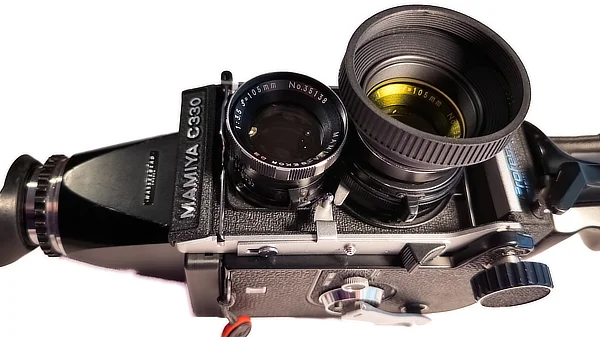
Svelte it ain’t…
Overview
If you haven’t guessed already, I was an outrageous camera snob in the Eighties. If it wasn’t Nikon or Rolleiflex, then I didn’t want to know. Leicas were for silver spoon poseurs wealthy enthusiasts and Hasselblads were priced so far into the Oort Cloud that my meagre undergrad budget couldn’t cope [ Note IX ].
As noted above, after a few years of struggling with the Rolleiflex T it was replaced in 1985 with a 2nd hand Mamiya RB67 Pro S.
At the time I briefly considered getting a Mamiya “Pro” C330 or C220 TLR, but wrote them off as bloated Rolleiflex wannabes. At any rate, buying another TLR after all the focus and parallax issues I had with the Rollei T was out of the question. Yashica Mat TLRs were likewise off the table as I considered them the antithesis of everything I wanted in a camera.
In retrospect I should have been less dogmatic and purchased a refurbished C330. Used prices were reasonable and 1970s models were easy to obtain, as there was always a healthy stock of trade–ins at almost every Sydney camera store. A C330 would have avoided most of my Rollei T issues and, despite the bloat, was still ⅔ the size of a hulking RB67.
Yes I know the ƒ2.8 or ƒ3.5 E/F Rolleis are famously compact, have fantastically sharp lenses and their focus action is sensually smooth. In particular the 1970s 3.5F Xenotar models have near–Hasselblad image quality, which Mamiya C lenses cannot match. They also come with enough bragging rights to satisfy even the most insufferable gear–head. (Who, me?) But, but… I had been burned by the Rollei T experience so TLRs were out.
Decades later I finally overcame my TLR aversion in Sept 2024 and bought a 1971 Mamiya C330 Professional from Sydney Super 8 at King Street Newtown.
It was purely an impulse buy. Originally saw a Rolleiflex 2.8E with lens separation & fungus, then noticed an excellent condition C330 for a surprisingly low price and quickly bought it. By comparison a similar age/ condition Rolleiflex 2.8F would have cost 5× more.
Mamiya C330 overview
The final two C330 production models were the C330 Professional ƒ
followed by the C330 Professional S
. Mine is the model which preceded them, the C330 Professional
. It seems the later ƒ
and S
variants used more plastic components to lighten the load, so maybe it’s a good thing I got the initial model. Admittedly the later two models have a better designed RHS shutter lock and LHS friction lever for more precise focus. The S
also has a redesigned single action waist level viewfinder and (it was claimed) brighter focus screen.
The much cheaper & simpler C220 is a whopping ½kg lighter (!), but you have to manually cock the shutter in addition to winding the film, just like the R–Bloody–67
. The C330 has internal gears for this, hence the extra weight, although you can still manually cock the lens to reduce stress/ wear on the camera winding mechanism.
C330 vs. Rolleiflex?
See Pavez Goye (2018) Rolleiflex 2.8E versus Mamiya C330
on YouTube (18:48 minutes).
C330 Features
Rolleiflexes were made as self–contained snapshot cameras with fantastic lenses, whereas Mamiya TLRs were system cameras designed for weddings and studio portraiture. Their main selling points were their lower prices, interchangeable lenses, a selection of focus screens and built–in extension bellows which allow significantly closer focus:
- 0.35m for the 80mm F/2.8
- 0.65m for the 105mm F/3.5
(Cf. 1m for the Rollei T Tessar 75mm)
The C330 bellows lets you get really close, almost 1:1.5 with the 80mm. No issues anymore with head & shoulder shots, indeed you can fill the entire frame with just a hand! Things are even better with the 105mm or 135mm, where you can do tight head shots but still remain far enough to not spook the sitter.
TLR = parallax issues. The C330 viewfinder has a LHS needle to act as a frame–top guide plus exposure adjustment; nix for the Rollei. For critical framing of static subjects, the “paramender” tripod accessory can help.
TLR = no mirror–slap. Which guarantees quiet vibration–free operation. The Hasselblad provides a separate pre–release switch to raise the mirror before tripping the shutter.
TLR = a quiet shutter. A surprisingly crisp little click
, as opposed to the bombastic KER–THUNK
of a Hasselblad or RB67.
TLR = laterally reversed viewfinder images, just like the good ol’ days, where left is right and vice versa. To keep with the Eighties vibe, I do my metering with a similar vintage Gossen Luna Pro F.
120 film = 12× frames per $AUD 30 roll, so make ‘em count!
Unfortunately the C330 doesn’t feel as “solid” as my other mechanical cameras, probably due to the large interior cavity for the lens and black concertina focus bellows. People online who whinge about its weight really need to take the “Hasselpanzer” out for a spin…
Aside from obvious things like close–up or parallax, an inherent weakness of all TLRs is controlling lens flare. With an SLR you view through the taking lens and directly observe what things will look like on film. With a TLR you have no idea because you are looking through a separate upper viewing lens, which often sees things differently to the taking lens beneath it. Flare in the upper lens may mean none in the lower, or vice versa. It can be infuriating, especially when shooting into the light. And yes rangefinder cameras suffer the same problem.
Another particular C330 issue is ruining slow speed shots by inadvertently jerking the shutter release at exposure. You really need a cable release (or a pistol grip) for peace of mind at s/speeds less than 1/125th. Despite having longer cables for my Hasselblads, got a vintage Kaiser 25cm release off eBay.
An additional benefit of using a cable release (or grip) is to keep your fat fingers away from the spring–loaded shutter–arming lever, which is too easy to impede during use and will yield a blank frame.
Then there is the dim viewfinder/ focus screen, mainly because you are looking through an upper ƒ2.8 lens designed for daylight or well–lit studio work [ Note IV ].
At least you can easily disassemble C330 focus screens to clean out ever–present dust bunnies. Nix for the Rolleiflex T.
Yet aside from the bulk & keeping your fingers away from the arming lever & and murky focus screen… the C330 on a cross–body strap works well as a walk around camera. When out and about I often get stopped by younger photographers: How old is your camera?!… Why does it have two lenses?… What kind of film does it use?!…
Accessorising The C330
- Replacement focus screen “C330 Brightscreen MPD #6613 screen”. Not overwhelmingly brighter than the original, but its 45° split–image microprism is a must–have for accurate focus
- New camera body leatherette using a pre-cut kit bought off eBay. The 1970s original was curling at the edges, so the new skin makes the camera look and feel like new
- Bakelite Mamiya M645 Series Pistol Hand Grip with built–in wrist strap. It needs to be used with a screw–in Abrahamsson (mini) “softie” to bridge the gap between pistol grip trigger and body “chin” release, but luckily there is still a bit of slack, preventing the shutter from becoming a hair–trigger. The adjustable wrist strap is also useful for a secure hold
- I originally tried a Hasselblad pistol grip (45047), which worked, but also tended to twist on the base no matter how much the ⅜” screw was tightened. Not an issue with the Bakelite Mamiya grip, which avoids twisting thanks to a pair of pins which register with sockets on the camera base
- Hasselblad viewfinders can also be used courtesy of a custom 3D printed prism viewfinder adapter. Mine was printed from a
Mamiya C-series adapter for Kiev88/Salyut prism viewfinders
STL 3D–file - For a while I used a Hasselblad NC–2 prism, but it made the camera very top–heavy. I now use a Hasselblad Magnifying Hood (42013) Type I “Chimney finder” (see image below) which, being mostly empty space, is much lighter yet still makes focusing and framing easy
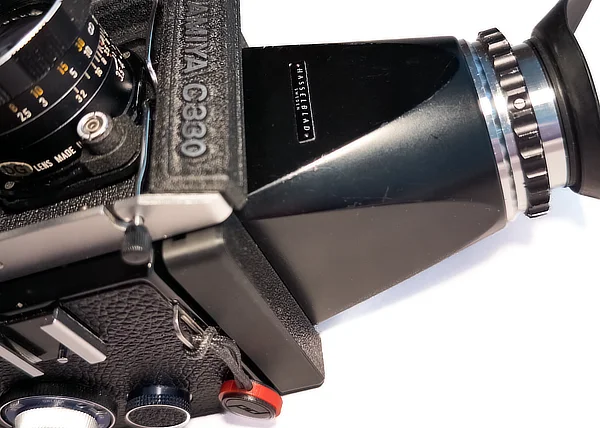
The camera with pistol grip and chimney finder is admittedly bulky and conspicuous, at which point why not just use the 501CM or 500EL/M?… For starters there is no mirror slap and the shutter is vastly quieter. It also has built–in extension bellows and — most importantly for this Furiously Independent Thinker — the oddball factor is off scale 🙃
Lenses
Currently use the following:
- Mamiya Sekor 80mm F/2.8 (black, silver dot)
- Mamiya Sekor DS 105mm F/3.5 (blue dot)
- Mamiya Sekor 135mm F/4.5 (blue dot)
Let’s get the bad news out of the way: Mamiya TLR Lenses do not score well on the online table of MF lens resolutions. It is claimed the Sekor 80mm matches the Rolleiflex T 75mm Tessar, yet both the Hasselblad 80mm Planar or Rolleiflex 3.5 Xenotar blow them away. You can clearly see the difference under a loupe; not a disaster, but a distinct downgrade in contrast and sharpness. In the optical olympics it’s Rodenstock/ Alpa → Schneider/ Zeiss → Mamiya. As a (small) consolation most vintage MF lenses were never designed to be hyper–sharp anyway, as 120 film requires significantly less enlargement than smaller formats.
80mm F/2.8
My silver dot 80mm F/2.8 came with the camera. Image quality? Mush at ƒ2.8–4, but okay at ƒ5.6–11. It is also sharper at 2–4m than infinity and contrast is muted due to antiquated lens coatings.
There are (unsubstantiated) claims the later 1980s Professional S
lenses with purple anti–reflection coatings could match Rolleiflex & Hasselblad in optical performance. Opinions vary furiously. FWIW all my Mamiya TLR lenses have the original yellow tinted coatings.
For B&W film, contrast can be improved slightly by using yellow or orange filters. Hence I always use a 46mm Hoya Y(K2) (HMC) filter, which requires only +1 stop exposure correction.
135mm F/4.5
In Apr 2025 I bought an excellent condition blue dot 135mm F/4.5 medium telephoto lens. Discovered upon delivery it was a bit of an oddball in that the taking lens aperture and leaf shutter blades are exposed at the rear. I thought I had been scammed, but upon investigation discovered it was a “feature” of the lens design (!)
A bigger quirk is focus, for it is not a true “telephoto” but rather a long–focus design. Meaning at infinity the flange distance has to be 135mm from the film plane, requiring you to rack the bellows out to almost half-way. Closer focus requires even more racking, eg. 200mm from the camera front plate (!) Thankfully if you remember to reset the lens focal length on the LHS body dial after mounting, the amount of parallax and exposure compensation remains the same as for the 80mm.
The good news though is the 135mm is sharp! Magnificent for full–face shots or closeup details.
105mm F/3.5
A month later I got a blue dot DS 105mm F/3.5 lens. It has replaced the 80mm F/2.8 for everyday use, as I find the slightly longer focal length (58mm equivalent on 35mm film) more convenient for most scenes, along with tighter crops for close–ups.
Similar to the 135mm it is a “long focus” design, so the focus bellows has to be extended (slightly) to achieve infinity focus.
Discovered upon receipt it had sticky shutter blades, requiring a trip to Camera Service Centre to be CLA’d. Luckily the original eBay seller refunded the service fee from the purchase price 😀
Mamiya TLR Lenses Generally
Resolution and contrast are nowhere near as good as Schneider/ Zeiss. Get Used To It.
Changing lenses on the C330 is convoluted but works:
- Cock the shutter
- Turn the LHS dial to lower the camera baffle slide (to shield the film)
- Disengage the front lens wire clamp release
- Mount the replacement lens & reengage the wire clamp
- Re–raise the camera baffle
- Set the appropriate focal length on the LHS dial to ensure the viewfinder parallax/ exposure compensation indicator is correctly configured
Sounds complicated because it is, yet with practice it is relatively straightforward. Admittedly it can also be easy to fumble a step, so I only recommend doing lens changes between rolls.
Because 2nd hand replacement lenses have become so inexpensive (≈ $AUD 300–400), if a shutter dies you can simply buy a replacement lens. Since the lenses are uncomplicated they are also easy to have serviced, provided your tech can source the parts.
Mamiya TLR lenses all use 46mm filters which are much easier to buy and cheaper than Rollei Bay I/ II. Searched my spares trunk and found B+W 46mm rubber hoods for the 80mm & 105mm which don’t impinge on the upper viewing lens (original Mamiya metal hoods retail for $120 on eBay).
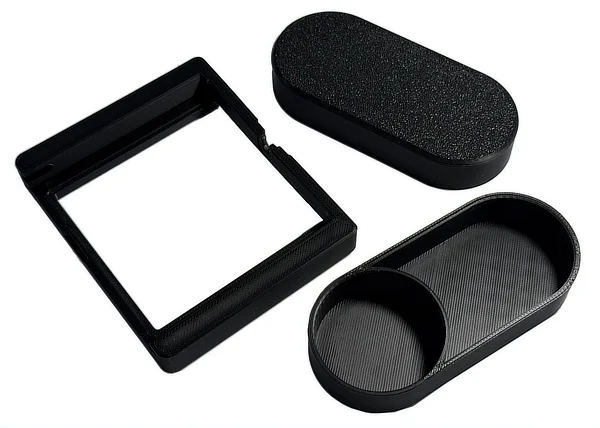
In May 2025 one of my neighbours 3D printed deep dual lens rear caps for the TLR lenses. He did a fantastic job and the new caps are better than the 1970s originals!
All lenses have leaf shutters which enable flash sync at any speed. A surprise is how stiff the shutter springs can be, which you can really feel when you manually cock the shutter. This may explain why so many used C330s have stripped/ jammed body gears from cranking by ham–fisted photographers.
Hasselblad 501CM & 500EL/M ↑
Famous brand this, despite attempts by clueless management to trash their own legacy in 2012 by releasing “Lunar” and “Stellar” re–skinned digital Sonys.
I won’t dwell on the entire 6×6 V System as there are plenty of others who have done so already: eg. Beyond The Aperture or Photoethnography. What I will do is note ‘Blad quirks and observations from my twenty years of use.
Overview
I bought my first V System Hasselblad from KEH.com in 2004: a chrome 501CM with A12 Type IV back and Planar T* CF 2.8/80 lens. In the early 2000s many pro photographers were ditching their ‘Blad gear to go digital AF, so 2nd hand prices dipped into “affordable” levels. I notice they have since rebounded to almost triple what I paid 😠
Although not as bloated as the RB67, I still found the 501CM + lenses bulky and a pain to carry around. Tried various camera bags & backpacks, but by far the best solution was a homespun camera trolley where a photo backpack is mounted onto a wheeled frame. Over decades have tried various configurations before arriving at my current two, referred to as Mir
and Sputnik
:
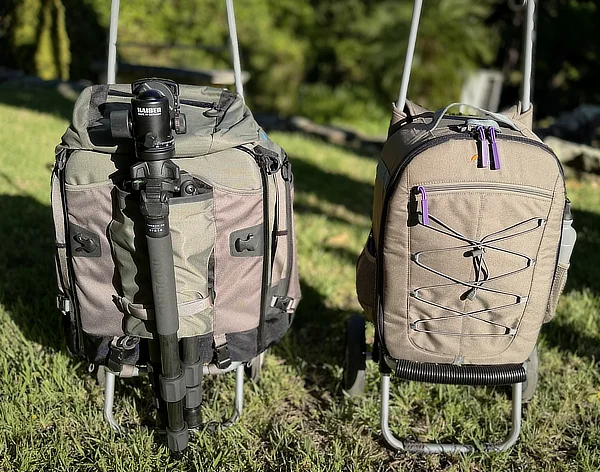
Both enable walking around for hours without breaking your back. They can hold a camera with mounted lens, along with secondary lenses and various film/ accessories. The smaller Sputnik
is for everyday use as it can hold a lot of gear yet still be easily wheeled around in confined spaces. The much bulkier Mir
, with its reinforced wheels, is for when I need to go in heavy and bring the proverbial kitchen sink.
503CW vs. 501CM
These were the last production 6×6 V System cameras before Hasselblad transitioned in 2013 to the 6×4.5 autofocus H System. Both 503CW & 501CM are fully mechanical and feature a “gliding mirror” mechanism to reduce vignetting for longer lenses or close focus, along with “palpas” internal anti–reflection coatings. The 503CW was the premium model with support for OTF/ TTL flash and a detachable motor winder. The 501CM was released a year later (1997) as a “more affordable” version without TTL or winder support.
As I didn’t need the additional features, I got the cheaper 501CM, followed later by a 500EL/M for motorised work. At the time the 2nd hand price for the 501CM was half that for a 503CW.
In Dec 2025 I got to play with a 1970s 500C/M (10022). It felt more solid than the 501CM, presumably due to tighter tolerances and greater use of brass internal workings. The focus screen was a different story, as I couldn’t believe how dim and murky it was. Give me a “budget” 501CM any day with its Acute Matte D screen and GMS mirror!
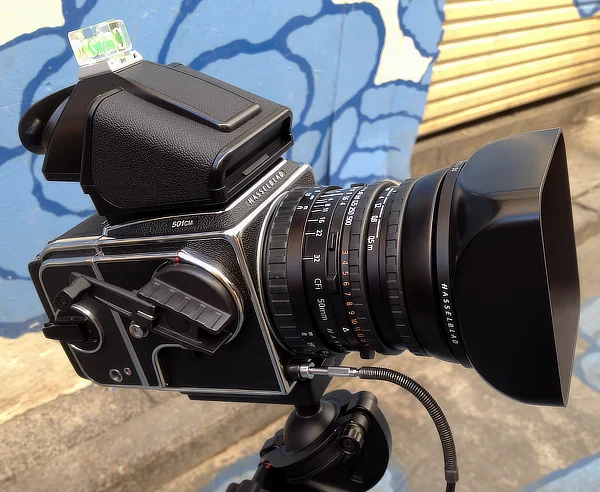
According to its serial number, my 501CM is a 2003 model, meaning it was practically new when I got it in Oct 2004. In twenty years it hasn’t let me down, aside from the occasional Hasselblad mis–cocked lens jam. For most of my early Boomer Legacy work it was used on a tripod, but from 2012 onwards I prefer to use it with a modified pistol grip.
The only snafu is its internal “palpas” anti–reflection coating, which after twenty years has begun to fade and crack. Cannot be helped alas and thankfully mine isn’t too bad. Interestingly the pre–palpas black coating inside the 500C/M I played with still looked pristine after fifty years…
Hasselblad 500EL/M
In recent years V Series “C” cameras have become extremely popular, although the same cannot be said of their motorised “EL” cousins. The 500EL/M (10219) I purchased in Oct 2025 was unbelievably cheap, admittedly without a film magazine nor finder and its focus screen in very poor condition. Compare this to a “mint” 503CW which can easily cost 10× more.
Motorised ‘Blads remain unpopular for a couple of reasons:
- They are loud and bulky as they were intended for studio use. The emphasis was on rapid operation and not “stealthiness”. Noise/ mass are irrelevant when the camera was designed to spend its working life on a studio camera stand
- Earlier models (500EL, 500EL/M) were powered by a pair of archaic 6V NiCad batteries (“DEAC 5/500 DKZ”) which could only be recharged in–camera. These (temperamental, expensive, heavy, low–capacity) cells were the bane of ELs, forcing Hasselblad to eventually abandon them for standard 5× AA batteries, even offering a conversion service for existing 500EL/M owners (as a penance?)
So why bother?…
Nail, say hello to hammer
. These things are fierce. They were designed to be simple and reliable and clatter along for 100Ks frames as they barrelled across the Russian Steppe. It’s no coincidence I refer to mine asThe Hasselpanzer
- Cheap. Collectors are so preoccupied with “MINT+” 503CWs that ELs tend to get ignored
- They are always armed and ready. Take the picture,
KLACK WEEEERRRT
and the mirror is returned with lens automatically re–cocked - It is the only camera I have ever used which requires a 1.5A slow-blow fuse. There are even three sockets for spares, so they must have been popping them all the time [ Note V ]. Fingers ✗’ed I haven’t blown one yet
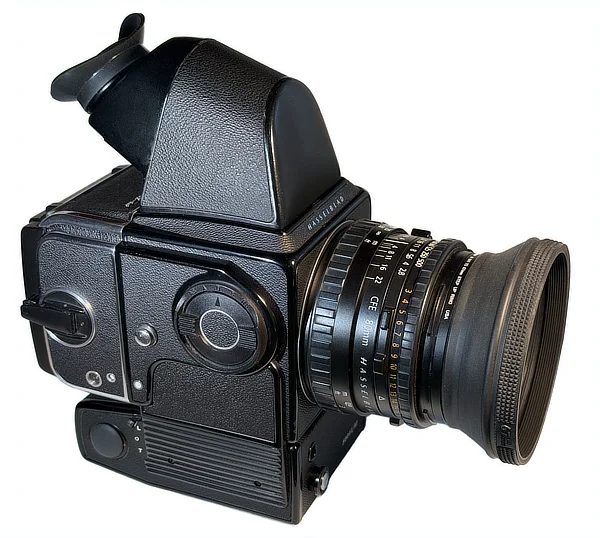
I bought an Eighties vintage 500EL/M instead of a more modern (say) 555EL/D, precisely because it was the older 2× NiCad version. These are very unpopular (ie. cheap), yet can now be powered by internal battery adapters which work better than the originals. I use a pair of “Hasselconverters” with USB rechargeable 8.3V 5400mWh cells, as lighter and more sustainable alternatives to 9V Alkaline/ Lithium [ Note VI ].
I specifically chose a 1983 model as it was late in the production run (1971–84) and, similar to my F3/T, was what I would have bought in the mid Eighties had I the $10Ks required 😕
The 500EL/M has a DIN socket for external power to recharge the NiCads, or for long electronic cable releases. It is located on the RHS motor housing beneath the A12 magazine frame counter. Haven’t played with it yet and have covered it with a cap made from Sugru silicone putty, which can be peeled off if required. Also used Sugru to replace the four cracked/ missing plastic feet on the camera base.
The 500EL/M lacks the “Gliding Mirror System” of later models, which in my case isn’t an issue as I only use 2.8/80 or 3.5/100 lenses on this body. If anything the simpler mechanism makes the camera (a tiny bit) quieter and (perhaps) more reliable.
Most of the time the EL/M is used with a dedicated “46221” pistol grip (see below), although I also have a “46063” FK–30 cable release for tripod/ monopod use. Furthermore, you can get after–market replacement shutter buttons which are threaded for a mechanical cable; haven’t bothered as I already have the FK–30 electronic cable.
Hasselblad Flexbody
During 2012–15 I used a Hasselblad Flexbody (3072109) whenever I needed tilt, shift and/ or closeup:
- Tilt: approx. ±28°
- Shift: approx. ±14°
- Bellows extension: 22mm
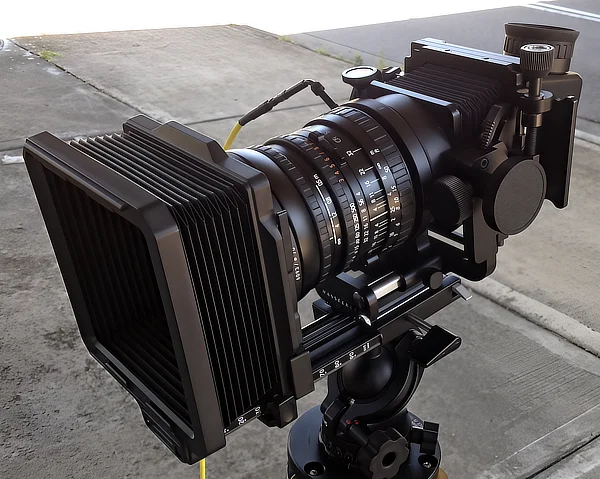
I mainly got it for architectural/ landscape work, where the Scheimpflug principle provides perspective control and increased DOF when the film plane isn’t parallel to the subject. Emphatically have never used it for “miniature faking”.
It worked as advertised and certainly looked imposing on a tripod. Yet it was incredibly fiddly, similar to a view camera only much more constrained. The lens was mounted with its centre line at 3 o’clock and you were limited to using standard V Series lenses, which only allowed modest amounts of tilt/ shift, unlike the Hasselblad Arcbody with its dedicated Rodenstock lenses. To arm a lens shutter, you rotated a small dial on the camera, then closed the lens prior to exposure by a half–pressing the cable release. You then swapped out the focusing–back & 90° viewer for an A12 film magazine, then advanced the film via the magazine crank (which on other ‘Blads you never touched mid roll). BTW don’t forget to remove the magazine dark–slide as there is no locking mechanism to remind you…
Which is all very pure & heroic, but in practice was a curse–inducing PITA. Shot my last roll with it in 2015 and kept it in a trunk until 2024, when I sold it without regret. Should I ever feel the urge to Scheimpflug again, I’ll get a Linhof Master Technica and be done with it. Or maybe even a digital tilt–shift lens.
Zeiss T* lenses
Come for the elegant V Series modular camera design, stay for the Zeiss T* lenses.
Mine are “CFi” versions, with reputedly the best ergonomics, lens coatings, internal anti–relfection blacking and reliable shutters. I had each CLA’d a couple of years after purchase, so they shouldn’t need servicing for another twenty years. (Some claim you need to do it every year. Yeah, right…)
Each lens has a B60/B70→67mm filter adapter ring to enable use of 67mm filters, lens caps and rubber lens hoods. Since I now use the ‘blads for B&W work, I have B+W 040 Orange filters to darken skies and B+W 022 yellow filters to lighten skin tones/ less dramatic skies. I have multiple copies of each filter to pre–mount before leaving home to avoid fiddling on location. Otherwise V Series lenses have their front elements recessed so deeply that I don’t bother with UV protective filters.
A lot of people wax lyrical about how “perfect” Hasselblad lenses are. Not I. While admittedly they are very good, they have nowhere near the resolving power nor colour fidelity of certain Leica R or M optics (see below), nor Rodenstock large format or Alpa lenses. Disagree? Mount a V lens onto a high MP digital camera and prepare for disillusionment. Nonetheless they are significantly better than Mamiya–Sekor C lenses on the RB67 Pro S or Mamiya C330 TLR.
Like most retro medium format systems, V lenses have built–in leaf shutters (B–1/500th), which enable flash sync at any s/speed. This was one of their biggest selling points prior to the advent of high speed vertical–travel shutters in the 1990s [ Note VII ].
I have 16mm (40541) and 8mm (40649) extension rings for closer focus. Neither have electrical contacts, which are the “16E/ 8E” versions, and while they don’t deliver true 1:1 macro, they work well for the occasional full–face portrait or close–up. They are also vastly cheaper than the dedicated Makro–Planar 4/120 CFE lens.
I have all the relevant Hasselblad boxy lens hoods, along with a Proshade 6093T (40739) matt–box, but prefer B+W 67mm rubber lens hoods on the 3.5/100 and 2.8/80 lenses, which do an excellent job shading/ protecting the front element and fold back onto the barrel for compact transport or storage.
Loading Film
This is far more fiddly than it needs to be. You have to learn to slow down, or else pre–load your films in spare A12 backs before use. Small wonder the Rolleiflex film “autoload” mechanisms were so beloved by harried 1960s press photographers.
The basics of film loading are covered in detail by M.Thomas (2012) Photo: How to Load a Hasselblad Film Back
on YouTube.
A few additional tips:
- Do it in a shady place. 120 film is comprised of a dual layer of film + paper backing, so it doesn’t require a lot of direct sunlight to leak around the paper edges to fog the film
- You don’t need to detach the entire A12 film magazine from the camera body, just pop out the film insert from the magazine shell
- Make sure the Hasselblad body is always cocked. This takes getting used to when coming from other systems, but with ‘Blads you do everything with the lens armed. If you don’t then you will lose the first frame when winding on. Up–vote for the 500EL/M which does it automatically after every shot
- The above YouTube video shows the importance of aligning the film–backing arrows with the triangular marker on the film holder clip. I always give it an extra 10mm to provide additional space between frame 1 and the film leading edge
- Film magazines (at least Type III & IV) stop at “12”, which is annoying as you cannot cheapskate an extra frame onto the end of a roll (a cool feature on Rolleiflex TLRs)
I currently have three A12 6×6 magazines: two type IV (with rear integrated slide film holders), and a type III (without). The type IVs stay on the cameras while the type III is used for “B Roll” when I quickly need to change films. Both III and IV types have the most up–to–date film transport mechanisms, yet their external appearance is dissimilar enough to easily distinguish.
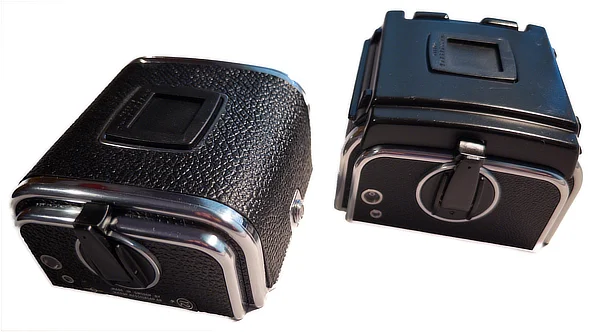
In case you missed it, A12 magazines only allow 12× frames per roll. At $AUD 30 per roll you better make each frame count. I have never tried the 16–frame A16 6×4.5 (30082) as you additionally need a 90° viewfinder plus a 645 focus screen cropping mask. If you decide to go down this road, be careful of inadvertently getting an A16S back, which is actually a 4×4 back for “super slides”, viewable in (some) 1970s slide projectors. “Slide Night” anyone?…
I wouldn’t bother with earlier magazine types, especially the “Magazine C12” (Type I) with its speakeasy peep–hole to align frame #1, although it is so wildly antiquated I may get one just for LOLs.
Some people obsess over having the magazine shell/ insert serial numbers match. I don’t, but wouldn’t buy a magazine if the insert was more than a couple of years different than the shell. Use this site to check Hasselblad S/Ns for manufacture dates.
Finally, am thinking of one day maybe getting a (3:2 crop) CFV ii 50C digital back. Surely at my age I don’t need both kidneys…
Prism Viewfinders
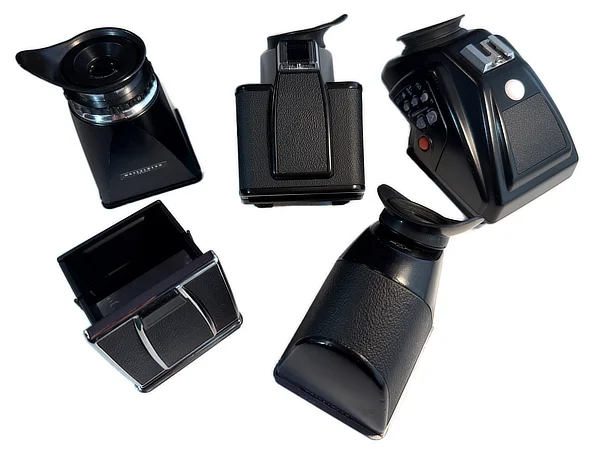
My 501CM came with a standard “42315” (chrome) folding waist level finder. It is light and compact when folded down, yet I found I was always popping the built–in magnifying lens for accurate focus. The L→R laterally reversed image also gets old fast.
A PM–5 (42308) 45° prism solved most of my issues and I still use it today. It also has a “cold shoe” atop the prism for a spirit bubble (see 501CM photo above), or a small flash for weak fill/ catchlight.
Since handheld incident readings can be tricky when using telephoto lenses, a few years later I got PME–45 (42297) metered prism. The PME–45 features built–in diopter view–lens correction along with a variety of metering options, including a small diffuser ball for incident readings, and uses a single CR2 V3 lithium battery which seems to last forever. Nevertheless I eventually stopped using it as I found it too ungainly, although not too heavy as the external housing is mostly polycarbonate. I also became paranoid as eBay prices kept climbing. Reverted to using the PM–5 and now keep the PME–45 in safe storage, should I ever need a deposit for a second car.
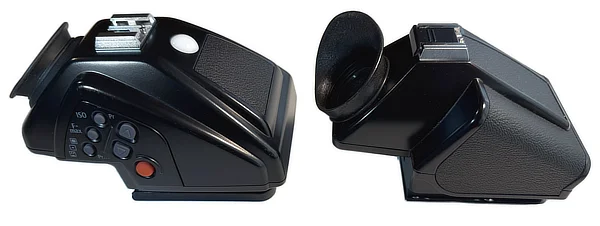
When I got the Mamiya C330 in 2024, I decided it needed a compact eye level finder. The original Mamiya options (Poro Finder
or Poroflex
or Eye–Level Prism Viewfinder
) were overpriced, ancient and murky. Since the king’s ransom PME–45 was out of the question, I got a Hasselblad NC–2 (52027) 45° prism, mounted via a 3D printed adapter. Worked (very) well, although it did make the C330 top heavy. When I got the finderless Hasselpanzer a year later, I moved the NC–2 over there and had to search again for a replacement C330 finder.
Ended up getting a KEH “bargain” grade Hasselblad Magnifying Hood (42013) Type I “Chimney finder”. It is light and works great, but annoyingly I’m back to viewing things L→R reversed again 😖
Pistol Grips
Initially used the 501CM on a sturdy tripod, which worked fine but was slow and a pain to lug around. Eventually got a much lighter Induro CT214 carbon fibre tripod, although handling remained slow/ bulky/ awkward.
Around the same time I bought a couple of 45° prism finders and started experimenting with using a monopod or else shooting handheld. The monopod worked fine but was still slow and bulky(ish), whereas hand–holding only worked at s/speeds above 1/125th, as things got increasingly shaky at slower speeds.
I then discovered Pistol Grips, which promised a reasonable compromise. Unfortunately there were none specifically designed for the 501CM (or 503CW), so I used a generic grip as a kind of chest pod and tripped the shutter via a short cable release.
It was clumsy and inelegant but worked. Yet This Would Not Do™. So I modified the trigger on a Kiev pistol grip and now we’re talking:
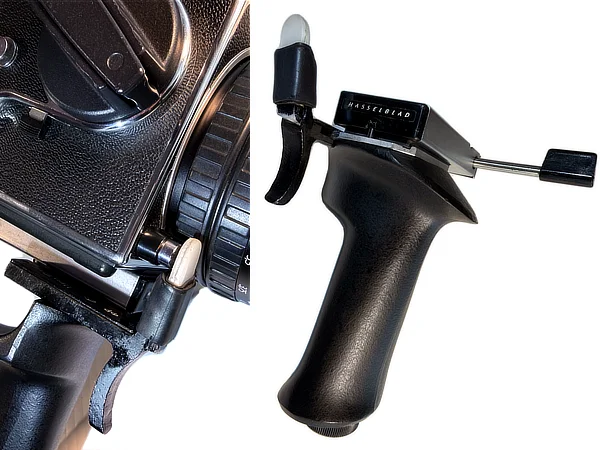
My 501CM grip is a combination of a modified Pistol Hand Grip Handle for Kiev–88 Salut–S with a Hasselblad Tripod Quick Coupling Release (45004). Later on I tried to similarly modify a Hasselblad “45047” Pistol Grip, but the Kiev–88 version worked much better as the 45047 had a slack trigger spring and didn’t let me attach the camera by sliding on/ off.
Have used my “frankengrip” for more than fifteen years now, and although it would make W.Heath Robinson smile, it mounts firmly and is secure. It works very well, even down to s/speeds of 1/30th. If I pre–release the mirror I can even get down to ¼ sec. Any slower and I’m back on a tripod.
For the 500EL/M, Hasselblad made a specific “46221” grip with an elongated trigger finger. It works great, but unfortunately lacks the slide–in convenience of my hacked Kiev grip, as you need to attach it by screwing into the ⅜” socket on the camera base. Consequences.
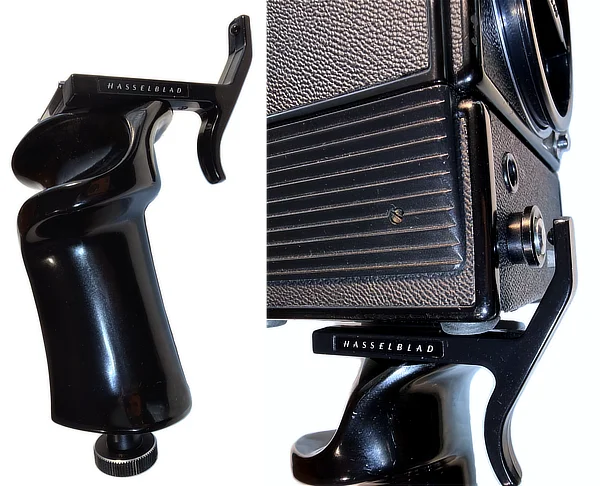
| Part # | Notes |
|---|---|
| Flashgun Brackets | |
| 45169 | For 501CM or 503cw, left hand grip |
| 45071 or 45073 | For the earlier 500 Series models, left hand grip |
| 46329 | For the motorised EL or 500EL/M, right hand grip |
| Pistol grips | |
| 45047 | For earlier 500 Series models |
| 46221 | For the motorised EL or 500EL/M |
Miscellaneous Accessories
Bay (60/70) Filter Adapter Rings
Purists will recoil in horror, but I have never used Bay–60 or Bay–70 filters. As noted above I use Tiffen Bay 60 (or Bay 70) to 67mm step–up rings which are made of aluminium and live permanently on each lens, although can be quickly removed if required. They enable use of easy–to–get 67mm filters, rubber hoods and lens caps. Since I tend to lose caps easily, any centre–pinch generic 67mm cap will do. Brand aficionados can spend big for a Hasselblad H (3053360) 67mm at £UK 18, or a Zeiss 67mm for $US 29 (+ shipping for both).
Hasselblad 45° Cable Release Adapter (50776)
These are available on eBay or online retailers. They make using a standard cable release less stressful for the shutter button as they provide free play for the cable to rotate and swing. They also angle the cable off to the side instead of going forward, which otherwise you then have to bend back (see the Flexbody and 501CM photos above).
Hasselblad “unjamming” tool
This tool is essential to help re–sync desynchronised lenses or bodies, where one is armed but the other not. One end of the tool is to re–arm lenses, the other for the camera body cam. They are available on eBay for ≈ $US 20.
Focus Screens
Acute Matte D (42215) came with my 501CM and is the only way to go. It has a central split–prism surrounded by a microprism collar, with a large crosshair to help with verticals. Unfortunately used prices have reached defence procurement levels (≈ $US 800!). Some money–grubbing diсkheads people even swap them out of motorised Hasselblads to sell the “42215” screen on its own for an obscene markup. In my 500EL/M I replaced the supplied screen with a Maxwell Precision Optics “Hi–Lux” resurfaced reference–cross screen (42165), which is bright enough and works okay. BTW “Acute Matte” screens can be easily distinguished by the double–dimple on the LHS bottom of their metal frame.
Prism Rubber Eye Cups
Have a nice prism but the rubber eye cup has deteriorated? Despair not, for you can replace it with a brand new Kiev clone for (Hasselblad relative) pennies: see Araxfoto.
Hasselblad Quick Coupling Adapters
These are mounts which attach to a tripod/ monopod head and allow “quick” mounting of the camera by sliding it into the adapter. There are many varieties (eg. 45004, 45128, 45130, 45144), so choose whichever you prefer. Many people ignore them and instead use an Arca Plate adapter on the camera base, to then mate with the ubiquitous Arca mount on their tripod head. Boat. Float. Whatever.
Current (35mm) Cameras
Over decades have used a large number of 35mm film cameras. Moved away from them in the early 2000s due to a preference for medium format film, but a decade later I started shooting 135 film again. The following are selection of models I currently use.
Section Quick Links
Leica R6.2 (1998–2017) ↑
I originally bought a Leica R6.2 (10073) in 1998 to replace the workaday Nikon F90X I was using for commercial QTVR panoramas. I chose the R6.2 because it was fully manual, didn’t require batteries (except for the lightmeter) and worked with my Leica FISHEYE-ELMARIT-R 16mm f/2.8 lens (11222):
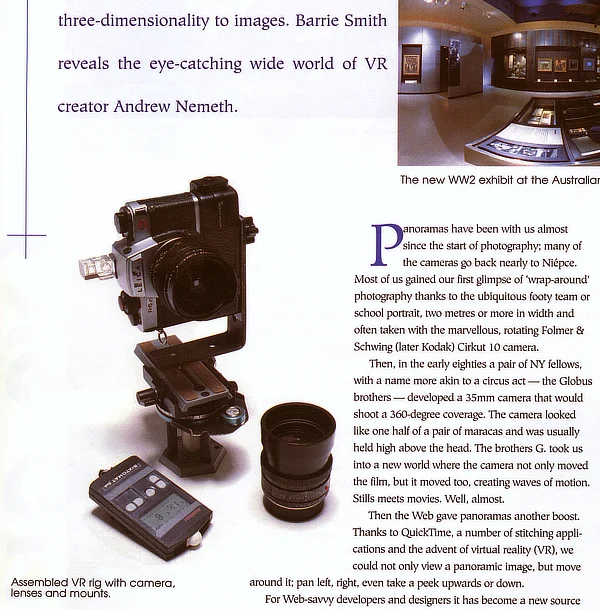
I was happy with the R6.2, but when combined with a Motor Winder R (14208) it became bulky and loud (+ heavy as the winder required 6× AA batteries). I subsequently sold it and moved on to using Leica Ms for most of my work.
During 2017 I bought a few Leica R lenses to use with my Sony Digital mirrorless bodies, then realised I also needed a Leica R body to occasionally shoot film. Initially got a Leica R7 but found it frustrating, so in May 2017 traded up for a 2002 Leica R9 Anthracite (10090) with an R8 Motor Winder (14209).
Leica R9 ↑
When the Leica R8 was released in 1996, it drew flak for being too heavy & bulky & trouble–plagued. Due to its unique visual design, which incorporated the viewfinder pentaprism into an undulating top plate, many critics derided it as The Buffalo Leica
or The Hunchback of Solms
.
Presumably the same critics also chortled when Canon released the similarly styled EOS R3 and EOS R1 digital cameras?…
Nonetheless the R8 was sufficiently successful to ensure an updated R8.2 R9 version in 2002. The new R9 kept the original design but is 100g lighter, has a top–plate frame–count display, exposure–mode wheel lock, updated electronics and is significantly more reliable than the (early) R8: see Harris, J. (2023) Leica R8 and R9 SLR walkthrough
at YouTube.
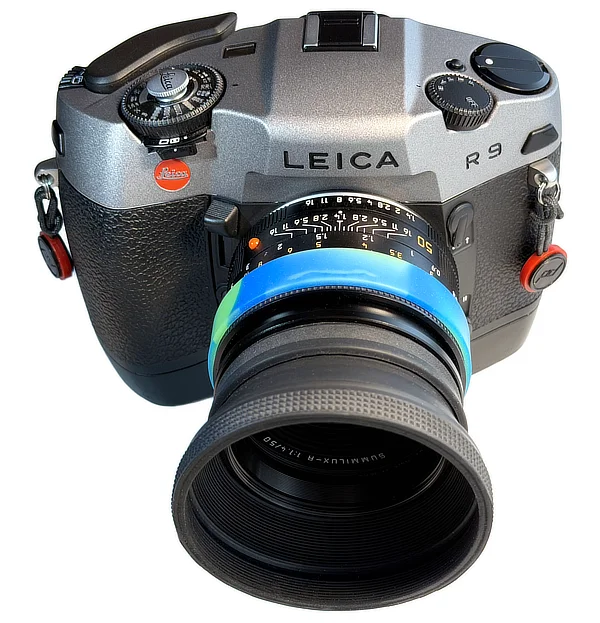
A note about R9 accessories above:
- The Summilux 50mm (E60) lens has a B+W 55mm rubber lens hood, attached via a Sensei 60–55mm step down ring
- The lens front element is further protected by a B+W “F-Pro” E60 UV filter
- A black silicone rubber ring separates the rubber hood from the (tokenistic) built–in hood, while a paisley blue silicone wrist band covers the lens focus ring to increase “gripiness” plus aid in identification (all my R lenses have different coloured bands)
- The camera base has a R8 motor winder
- Peak Design Strap Anchors in the camera eyelets
- The shutter button has a 12mm chromed brass Leica Soft Release button (14015)
- The flash shoe has a Nikon BS–1 accessory shoe cap
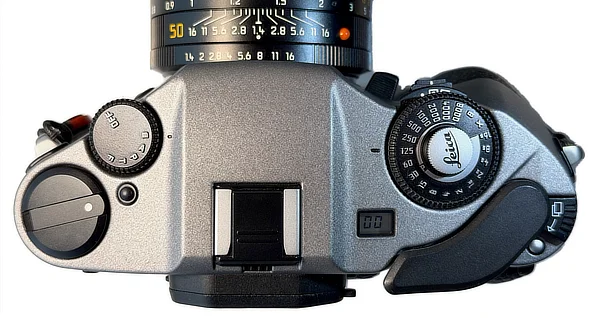
A pair of CR–123 3V lithium cells inside the R8 Motorwinder power the camera’s lightmeter and electronics. Without a winder, the R9 body uses two smaller CR2 3V lithium cells. I have no idea how long these CR2s last, as I have always used the larger CR–123s cells in the winder. One thing is certain though, the pair of CR2s last much longer than the button cells (or single CR1/3N) in the Nikon F3 (presumably why Leica chose them). Unlike the F3, the R9 has no mechanical backup shutter setting. Dead batteries = dead camera.
R9 Likes
The R9 is my usual go–to for shooting 135 film (that’s 35mm film folks), especially for wide angle or telephoto work. It has a number of benefits which make life more enjoyable:
Access to “Hollywood” R lenses
At a time when “CaNikon” were betting their future on autofocus, Leica R lenses remained defiantly manual focus. I personally didn’t care, but a helluva lot of others did, causing sales of R cameras and lenses to collapse in the early 2000s.
So I was lucky when I bought most of my 2nd hand Leica R lenses in 2017, as by then prices had cratered due to perceptions of “R” being a dead system. Again I didn’t care as I intended to use them with adapters on Sony mirrorless cameras. But a few years later videographers discovered R lenses and prices rebounded. Why? Because their optics feature pre–digital spherical designs, where in–focus portions of an image are sharp, yet the remainder is “rounded” and “smooth”, unlike digital–era lenses which can sometimes be harsh and “clinical”. Nearly all my R lenses are the final versions before Leica abandoned the system; sharp & smooth rendering, metal barrel construction, damped long–throw focus, firm–click aperture rings, ROM chipped.
Vintage Leica M lenses similarly exhibit this “smooth rendering”, but due to their non–telecentric designs they don’t play well on most digital cameras, resulting in heavy vignetting and frame edge artefacts. By comparison R lenses were designed for SLRs with a much longer flange focal distance (47mm vs. 27.8mm for the Leica M), vastly reducing edge artefacts.
Then there’s physics. M lenses are famous for their image rendering and precision construction. But R lenses, because they are much larger, can be made with even greater precision because their constituent parts are bigger and farther apart, allowing for more generous tolerances during manufacture and assembly. This partly explains why the focus throw on R lenses can be 2–3 times longer than for equivalent M lenses. There are also no rangefinder focus–cam limitations, so R lenses can typically focus much closer.
This R lens “sharp but smooth” rendering is similar to classic Hollywood Cooke and Panavision Primo–L (and other) cine lenses, which can cost ten times as much. Long–throw R manual focus mechanisms also make them easier to use in focus rigs. Which hasn’t escaped the attention of cinematographers, who snap them up to be modified or even rehoused for movie productions. If people with deep pockets want something desperately enough, then prices will inexorably soar.
Things are getting ridiculous. At the Sydney Leica store in Apr 2026, I was offered a used Leica Super–Elmarit–R 15mm F2.8 ASPH. ROM (11326) in pristine condition. As only 420 of them were made, they have become keenly sought after by cinematographers and collectors. The asking price? $AUD 14K for a 20–year old lens (!)
R8 Winder
The R8 winder (14209) carries over from the previous camera model and is IMO essential. Its larger CR–123 batteries last forever and having film automatically advance after each frame is a godsend. Motorised rewind is “leader out” by default (ahem, unlike the Nikon F5). I wouldn’t get the 4.5fps R8 motor drive (14313), as it is enormous and uses an oddball battery pack which can only be recharged via a custom charger. Ditto the winder add–on Leica Power Pack MW-R8 (14250). In case you missed it, without the winder you need to advance film by hand as the R9 lacks any built in motors.
Beefy
Dainty it is not. Being a third larger than the pro champ Nikon F3, which was still in production when the R8 was released, people know you mean business when you whip out an R9 👊 Its larger top surface also spreads everything out so its non–protruding controls and dials are easy to access and use, even in gloves.
Film Autoloading
Nikon and Canon had it for years, but it took Leica a while to come to the party. Slap a film cassette into the chamber, pull the leader across the gate and close the back, winding on will do the rest. It makes me smile every time (and try not to think too much about loading a Hasselblad A12 magazine or (shudder) Leica IIIG…)
The film chamber has DX contacts which, if you prefer, automatically read and set the ISO from barcoded film cassettes. I tend to load my own B&W film from bulk 30m rolls, so I bought a dozen reusable 100 ISO DX encoded cassettes off eBay.
Only 36 frames…
… so make ‘em count. Like any film camera really, plus a huge detox from mobile phone scatter–gun paradigm.
Multi–Pattern lightmeter
In my lightmeters section you will notice I am a handheld incident–reading bloke. Although the much hyped Nikon F4 matrix meter didn’t impress, the R9’s multi–pattern meter keeps surprising with how accurate it can be. Usually. Of course things go awry with light or dark scenes, but otherwise it is (mostly) spot on. Naturally it works with any 3–cam or ROM lens, unlike the Nikon F5 which only permits matrix metering with modern CPU embedded lenses.
Winder or manual-advance
This is pretty cool. When you need to tone down the Girls On Film
clatter, you can disengage the winder by simply pulling out the manual film advance lever and then wind on by hand for as long as you like. When done, push the lever back and the winder resumes control. With the R6.2 “Motor Winder R” you have to partially extract the battery housing to get the same functionality. Motorised rewind is also available, leader in or out, but I mostly do it by hand to conserve batteries. BTW the winder can continuously deliver ≈1.5fps when you hold down the shutter release button. The 1990s klack–yeowr–klack–yeowr
is quite loud though 😕
Exposure ± lever
When shooting in auto–exposure mode, which I admittedly rarely do, the rear ± lever is handy for quickly adjusting exposure with your left thumb, without removing your eye from the viewfinder.
“MAPTF” Exposure Modes
“M” (fully manual), “A” (aperture priority auto), “P” (program fully auto), “T” (shutter priority auto), “F” (for flash metering). Most of the time I use M for Manual
. The R9 has a mode lock button to prevent the wheel from accidentally shifting, something which bedevils R8 users.
Dedicated “F” mode
F is for Flash (metering)
. As explained in a 2002 photo.net post, the “F” Mode enables the built-in flash meter only. You manually set the X–sync (1/250th) and your estimated lens aperture, then trigger the flash via the DOF lever (not the shutter button). The camera will measure flash exposure then indicate any change in the viewfinder. “F” works best with manual or auto thyristor controlled flashes. TTL is proprietary of course, so you need Leica OEM flashes (eg. Leica SF 24D) or (say) a Metz 44 MZ2 with SCA 3502 adapter. Although “F” works as intended, it will surprise no one when I say you are better off doing it with a handheld incident flashmeter.
Clear optical finder
Modern digital EVFs can be bright and clear and the Nikon F5 viewfinder is fantastic… but Leica SLRs have had it since the 1970s. There are a range of interchangeable R9 focus screens available, including one with a framing rectangle for the crop–sensor 10MP Digital–Modul–R digital back, released in 2005. I use the standard focus screen with a central split prism surrounded by a microprism collar. Am still waiting for digital cameras to implement something similar.
The R9 viewfinder supports manual diopter adjustment, as does the R6.2.
-

When shooting film I usually prefer medium format. But the Leica R9 is for when I wish to travel “light”
The R9 (with winder) is a delight to use. Yet remains obscure and unpopular due to the “hunchback” stigma plus no autofocus, a deal–breaker for many. Extortionately expensive R lens prices don’t help, neither does the R System being abandoned by Leica in 2009. Saying abandoned
isn’t hyperbole, as Leica sold off all their R production equipment/ spares and petulantly refuse to service R gear anymore. Luckily there are still a few aging 3rd party technicians who can do basic adjustments and repairs. Which may explain why used R9 prices remain relatively subdued 🤔
Nikon F3/T ↑
A couple of days before this article went live, I took delivery of a rare(ish) black chrome Nikon F3/T (1694). As noted at “lens–db.com”:
It is very hard to find a mint or near mint F3 black Titanium today.
Yeah well, in Feb 2026 I found one.
A month later I purchased a MD-4 motordrive and “film leader out” MF–6B camera back. Also got a replacement DK–17F rubberised eyepiece as the original was missing from the DE–4 HP prism [ Note XI ]. The AR–9 soft release button came with the camera.

When the F3/T arrived I had it CLA’d out of caution. FOUR weeks later 😖 the tech reported the shutter/ transport mechanism appeared pristine. His guess was maybe < 20 rolls had been put through. It would seem the camera has spent the last few decades sitting on a shelf or locked in someone’s safe.
Them Controversial Batteries
The Nikon F3 received a lukewarm reception when it debuted in Mar 1980. Unlike the legendary F or F2, Nikon’s new NASA endorsed flagship turned out to be entirely battery dependent. There was a mechanical ≈1/60th backup speed plus time exposure “T”, but otherwise all functions required electrical power. It might have been okay if it used a hefty 3V battery like (say) a Lithium CR123A, but at the time your only option was a pair of dinky 1.5V silver–oxide EPX76 watch button cells.
Pursed lips. Cranky letters to magazine editors. Droll remarks about only the strap eyelets, film–reminder holder and tripod socket still working when the batteries die. Pros around the world clutched their beloved mechanical F2s just that little bit closer to their sinking hearts…
A common misconception was the batteries were needed to drive the new stepless shutter. Not so. Instead they power the new exposure timing and camera control circuits, which use far less energy. The shutter itself, like earlier mechanical Fs, is powered by mechanical energy stored from advancing the film, either by or hand or motordrive. A new quartz timing circuit replaces the usual gears, springs, actuators and other mechanical devices, hence the lack of buzzing during long exposures. This also makes the shutter more reliable and precise (eg. ¼ sec is consistently 250ms). Not coincidentally it also makes it more robust for extended 4fps motordrive sequences.
If only Nikon and magazine shills reviewers had spelled this out. They mentioned the shutter was electromagnetically controlled
, but many misread this to mean electrically powered
. Lost in translation I guess. Nevertheless people quickly realised “Batterygate” was overblown and a Lithium 3V CR1/3N could easily last a year before replacement. Which shouldn’t be surprising, given the F3’s frugal electronic design. That said please note:
Regardless of whether the camera is switched off or not, the Nikon F3 always discharges a small amount of electricity because it incorporates a quartz oscillator circuit.
None of this bothered press photographers and photojournalists, whose F3s were equipped with MD–4 motordrives, which have 8× AA cells to externally power the camera (you can even remove the in–body cells while the MD–4 is mounted). This made battery anxiety a non–issue, especially after the release of lithium AAs in 1992. Admittedly the F3/ MD-4 combination is bulky, although not as bad as the F2/ MD-3 it replaced.
Nikon eventually solved the battery controversy by releasing the Nikon FM3a in 2001, which had an innovative hybrid shutter capable of both battery (AE exposure) and mechanical (manual exposure) timing control. Opinion remains divided over whether the FM3a shutter is as robust as the F3’s (one would suspect not). Subsequent F4 and F5 cameras were entirely powered by AA cells.

“T” for Titanium
Nikon started experimenting with titanium alloy body plates in the late 1970s, even releasing a few rare F2 titanium models. They later supplied a metering DP–12/T titanium F2AS Photomic finder for use with these “Titan” cameras, the precursor to the titanium DP–30 which came with the F5.
Furthermore, Nikon had made titanium foil shutter curtains since 1959, giving them extensive experience of working with the tricky material. So it wasn’t unexpected when they released a F3/T titanium body version in 1982, not a rare collector edition either, but a standard production model. The initial run had a bare metal “champagne” colour, but Pros baulked at its luxe and conspicuous appearance, so production shifted to a low–sheen dimpled black painted finish, as per the photos above.
Unlike the Leica M “titanium” models, the Nikon F3/T uses solid titanium alloy body panels and not merely a titanium nitride coating applied to zinc or brass body parts. Yet there is surprisingly little weight difference between the standard and titanium F3 versions, implying extra Ti was used to reinforce panels. This makes the F3/T a tough little bastard and helps explain why mine is dent free, despite being 37–years–old when I got it.
Mine was made in July 1989, according to the production code located beneath the camera back hinge.
Handling the F3/T feels slightly unusual in that titanium has a much lower thermal conductivity than brass or zinc, so it takes longer to warm up or cool down when you put it away. Not a huge difference, but it is noticeable.
Another titanium quirk is paint doesn’t adhere well. My F3/T has a few scuffs on its corners, usually fixable on other cameras with a black paint–pen. Unfortunately on the F3/T the retouched paint rubs off easily. More experimentation is necessary…
Party like it’s 1985
I won’t churn through every F3 spec and feature as there are plenty of others who have done so already. It eventually became Nikon’s most successful professional system camera, with a production run from 1980–2001 and claims of 3M made. They were still rolling off the production line after the subsequent F4 was replaced by the F5!
Similar to my “Hasselpanzer” in 2025, I mainly got the F3/T because it would have been the 35mm camera I bought in the Eighties, had I the (considerable) funds [ Note X ] and not been so belligerent about its dependence upon a pair of dinky button cells 😕
Using it today is a wild Eighties throwback. Classic build quality with angular design; Manual focus; Smooth film advance and tactile levers; Loud ‘n’ chonky 4fps MD-4 motordrive; Aperture priority (only) exposure automation; 80/20 centre–weighted exposure metering; Exchangeable focusing screens; Interchangeable 100% coverage (dust–prone) viewfinders; No built–in diopter correction; No body battery–test indicator; Periscopic ADR aperture display; Tiny LCD viewfinder display with finicky micro–LED illumination; Minuscule ASA film speed numbers; Fingernail operated switches; Both hands to change the exposure compensation dial; 150K actuation horizontal–travel Ti foil shutter; 1/80th flash X–sync; TTL with Nikon SB flashes (only); Accessory AS–4 flash coupler for everything else. Rugged dense metal Rambo II construction. Asymmetrical haircuts, padded shoulders, oversized spectacles, Sizzler and wine coolers. Klack Klack Klack to the tune of Don’t you (forget about me)
while “Ronnie Raygun” and Pershing IIs loom ominously over the horizon…
Nikon AiS lenses
Over decades I have used a variety of 1980s & 1990s Nikkor F lenses. Too many to list, but have found the best to be:
- 28mm ƒ2.8 Ai–S
- 50mm ƒ1.4 Ai–S
- Micro–Nikkor 60mm ƒ2.8 AF–D (no field curvature!)
- 105mm ƒ2.5 Ai–S (NGM Afghan girl cover)
Eighties era zoom lenses were mostly substandard, requiring Pros to stagger around with multiple camera bodies, each sporting different primes.
My F3/T came with a “pancake” Nikkor 50mm F/1.8 Ai–S, which presumably was part of the original 1989 kit. I don’t use it, preferring instead a more modern Voigtländer Ultron 40mm F2 SLII, which I previously used on my digital Sonys from 2014–19.
My 40mm Ultron SLII is the 2012 version and not the optically identical but larger/ heavier 2017 faux Nikkor 40mm Ultron SLII–S. Both have the AiS aperture ridge, so work equally well on post 1977 Nikon bodies.
I also have a spare 3rd cam Leica SUMMICRON-R 50mm f/2 II (11345), which I may adapt one day using a Leitax Leica→Nikon lens mount conversion kit. We’ll see.
Unsurprisingly all my manual Nikkor lenses play well on the F3/T, although the image in the DE–3 HP viewfinder is a bit small at 0.75× for rapid single–turn focus. A DK–17M magnifier eyepiece would address that, but for > $AUD 300 no thankyou. Swapping the standard “type K” focusing screen with a red dot brite–screen “type P” helps. Since there is no built–in viewfinder diopter adjustment, you cannot use the +1 diopter lens hack I use with the Nikon F5 (see below).
As noted earlier, even the best Nikkor Ai–S glass, while very good, cannot match Leica R ROM lenses for their resolution and “sharp/ smooth” rendering. Have found the Voigtländer 40mm SL II, with its bokeh friendly 9–blade circular aperture, a good compromise, albeit with a slightly wider FOV in comparison to “nifty fifties”. Close focus at 38cm is also handy (versus 60cm for the 50mm pancake) plus it has an auxiliary close–up lens which screws into the lenshood to provide 1:4 magnification. When I need to go 1:1, the flat–field Micro–Nikkor 60mm AF–D is an obvious choice.
Nikon F5 ↑
Was having so much Nineties fun using the F3/T+MD-4 that in June 2026 I got another retro motorised monster: a Nikon F5.
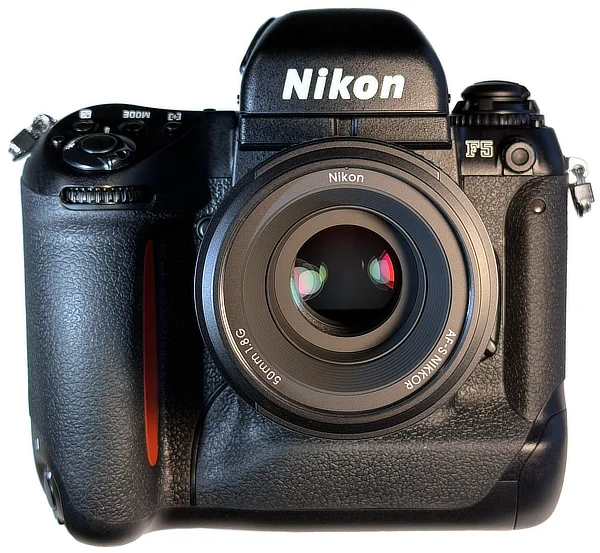
Am amazed by how inexpensive they have become: I paid less than half what I did for the Nikon F3/T+MD-4 four months earlier (!?) According to its “3107nnn” serial number, my F5 was made in 1998 yet is still in (almost) box–fresh condition. The only issue is its DP–30 pentaprism release button, which is stiff enough to require a wooden skewer to fully depress the prism catch. Otherwise the 28–year old camera looks, feels and performs like new 🏆
Reviews/ Features
Again I won’t bother outlining history/ features as there are plenty of others who have done so already:
- Nikon F5 Technical Guide (1996) PDF download (28MB)
- Dirk Halstead (Time Magazine photographer) 1996 F5 review
- Thom Hogan (2012) Professional shooter review
- Stahlbrandt (2021) Prosumer review
- Wesley King (2023) Beyond the Aperture Review
AF Lenses
I only have two Nikkor AF lenses: the aformentioned AF MICRO–NIKKOR 60mm f/2.8D for portraits and 1:1 macro, plus a new AF–S NIKKOR 50mm f/1.8 G for general purpose.
The 60D uses the mechanical 1990s screw–drive AF mechanism, which the F5 can crank really fast due to its high–torque motors. The more recent 50G has an integrated Silent Wave Motor, making operation almost instantaneous and silent (hence the “S” in “AF–S”). The 60D has a physical aperture ring while the 50G doesn’t, ruling out its use on older Nikon bodies.
Because the lenses have differing filter diameters, I have employed step–down rings to standardise on a 55mm ø filter: 62→55mm for the 60D and 58→55mm for the 50G. Choosing 58mm for both would have made better sense, but this way enables use of my pre–existing assortment of 55mm filters + lens caps for my other lenses.
The image quality from either lens is superb. The 50G is a new formulation and arguably the best Nikon 50mm until the introduction of the Nikkor Z range of mirrorless lenses. The 60D has almost zero field–curvature and when manually focused at ƒ8 is unbelievably sharp. Have used the 60D for years to digitise my 135 and 120 film images, so it is more than good enough for general use or “every pore & wrinkle” portraits. I am aware it has been superseded by the Micro–Nikkor AF–S 60mm f/2.8 G ED N, but the venerable 60D with its aperture ring has the advantage of working on older cameras like my F3/T.
F5 Random Notes
- Custom Settings
- There are 24 custom camera settings, only identified by cryptic #01–#24 numerals on the rear LCD. You have to memorise what each does or carry around a
Custom Setting pocket guide
. For my camera I have set #10 (“CL” film advance) to 4fps and #12 (motor auto stop) at frame 35. Set and fuggetaboutit. - Motorised Film Rewind
- Works well and is fast, although by default film is fully rewound into the cassette. If you want “leader out” then you either have to rewind by hand, or send your camera to an authorised Nikon Service Centre for them to firmware enable motorised leader out. I did this as soon as I got the F5 and it required Another Four Weeks for it to return. You would think one of the cryptic Custom Settings would address this but… “00”. In 2004 Nikon (grudgingly) got a clue and provided a user–configurable “leader out” custom function on the Nikon F6.
- Serviceability?
- When I (eventually) got my F5 back, there was an all–caps warning appended to the service report:
NOTE: WE CAN NOT GUARANTEE REPAIRS ON FILM UNITS AS WE CAN NO LONGER REPLACE PARTS
. Let that be a lesson to you: haven’t you heard film is dead?… Presumably 3rd party repairers can do simple things, but similar to what Leica did in 2009 for their R range of SLRs, NIKON HAVE SO MOVED ON FROM THEIR PRO FILM CAMERAS. - Shutter
- Conservatively rated for 150K actuations. Each shot gives a short duration staccato “klack”. The vertical travel shutter allows flash X–sync at 1/250th, although you can set it to 1/300th via Custom Setting “#20”: for manual or shutter priority modes only. A very big deal was/ is made about the self–diagnosing and adjusting shutter mechanism but… shrug.
- Autofocus
- There are five selectable focus–points clustered around the frame centre, a significant improvement from the single point on the Nikon F4. You use the film door thumb–trackpad to switch between points, and can lock them using the “L” button beneath the camera’s rear utility flap. There is a ≈1 second delay between changing a focus point and its box becoming highlighted, which requires getting used to. The AF box colours alternate between light and dark grey, making them unobtrusive but also at times hard to see. I haven’t explored “Dynamic AF” yet, which appears to be an early version of the “Wide AF” setting on modern cameras.
- Interchangeable Focusing Screens
- A large variety of F5 focusing screens were made. Earlier F3 or F4 screens cannot be used because they lack electrical contacts for focus point highlighting. I find the standard EC-B screen works fine, although eventually I will get a Type L for manual focus lenses, which is similar to the previous “Type P” with a 45° split prism and large crosshair to help with levelling. Current prices are depressingly exorbitant, likewise for DW–30 waist level finders 😡
- Long life LCDs
- All the LCDs on the F5 remain pristine after decades of use, unlike the LCD bleed which plagues the Nikon F4.
- Boosting the Viewfinder
- The titanium clad DP-30 prism is a high–eyepoint design with 0.75× magnification. I find the image a bit small, so have added a Nikon “2951” +1 diopter eyepiece correction lens and then readjusted the prism diopter knob to refocus and effectively boost the magnification by ≈10%. A DK–17M magnifying eyepiece would have done it better, but not for hundreds of dollars more.
- “3D Color Matrix Metering” — conditionally
- It was designed to give correct exposure for finicky E6 colour transparency film, so it’s surprisingly accurate with more forgiving B&W negatives. Alas the salarymen who disabled the “leader out” film rewind also deactivated Matrix Metering for manual F–mount lenses. On the F4 you could use any F lens with matrix metering, but on the F5 it’s strictly 禁断.
- Electronic Rangefinder
- Despite deliberately impairing a few F5 features, electronic focus–confirmation for manual Ai–S lenses works well and triggers the green in–focus LED when focus in a highlighted focus–point is detected 🙌. Have also found the focusing screen so bright and clear you can often focus manually by simply using the screen surface.
- Cable Release
- Mechanical releases no longer work, so you need to get an electronic MC-20 or MC-30 cable. Luckily both are inexpensive and easily obtainable 2nd hand.
- Hot–shoe missing screw?
- The flash shoe base has a hole in it which I thought was from a missing screw. Upon investigation I discovered the following:
[There is] an extra hole in the hot shoe to accommodate the security pin of the SB-25, SB-26, SB-27, and SB-28 flash units
. Of course the Nikon BS–1 accessory shoe cap still fits fine. - Check for leaked batteries
- Lithium AA cells became available in 1992, yet they were (and remain) more expensive than alkaline cells, so people continued using alkaline. Unfortunately these had a tendency to leak, so you need to carefully inspect your newly delivered
MINT++
F5 battery chamber/ caddy for any white powdery corrosion residue. A small amount is okay, provided it doesn’t affect the metallic electrical contacts. Clean it out by wiping with a damp (not soaked nor dripping wet) cloth. If the contacts are corroded however, then send the camera back pronto. A slight amount of dulling due to oxidation is easily fixable though, by rubbing with a pencil eraser. - The last “Pro” Nikon film camera?
- When the F5 shipped in 1996, the Digital Writing Was Already On The Wall. The wildly overpriced 6.2MP crop–sensor Kodak DCS 460 had debuted a year earlier, whereas the more affordable 2.7MP crop–sensor Nikon D1 came out in June 1999, midway through the F5 production run. The Nikon F6 was released in 2004 when F5 production ended as a “farewell to film” successor, by which time most pros had transitioned to DSLRs anyway. Incidentally the F5 was the last film camera used by NASA before they moved on to using a modified F5 with digital innards (the Kodak DCS 760).
- “Just get a Nikon F6 !”
- In 2026 a used F6 cost triple an equivalent condition F5. Furthermore, if I want to monkey around with firmware updates and menus on LCD screens, then I’ll grab a real digital camera thankyou. Finally, the dead–man–walking irreparable clock battery is a worry.
- “Just get a Nikon F100 !”
- These “only” cost double, but lack the F5’s premium materials, build quality and Hollywood lore. The notoriously fragile door latch doesn’t inspire confidence either, nor does its gradually deteriorating sticky rubber body grip.
- There are two shutter speed dials, which swap over at 1/30th second. The slow dial (B–1/30th) is on the front plate and the standard dial (1/30–1/1000th), which also spins when you trip the shutter, is on top
- The top 1/1000th speed is
serving suggestion
only. You’d be lucky to get 1/800th, and that’s with a fair wind and all your pockets stuffed with four–leaf clovers - You have to advance the film before setting the shutter speed, and notice how the top s/speed dial slowly rotates as you turn the film wind knob
- You need manually reset the film counter dial after (eventually) loading a new roll of film
- The horizontal–travel shutter curtains are made from rubberised silk cloth, which makes them very quiet. Nikon started using dimpled titanium curtains in 1959 because LTM users complained their cloth shutters would burn through if you left your camera face up in the sun…
- There are two viewing windows: use the LHS rangefinder for focus and the RHS viewfinder for framing. At least they are located beside each other on the IIIG. On earlier “Barnack” models they are well separated, forcing you to shuttle between the two
- Lenses screw on and off, which is secure albeit slow, with some lenses ending up misaligned with the centre–line not quite at 12 o’clock
- After more than six decades the rubber vulcanite body material is so old it tends to be crumbly and flake off. Luckily there is an easy fix: scrape the damn stuff off and re–cover using new self–adhesive pre–cut vinyl leatherette (did this for mine)
- Film loading requires patience, meticulous dexterity, a couple of pills and a large cup of tea: see Camera West TV (2020)
How To Load Film In A Leica Screw Mount Film Camera
on YouTube -

An allegorical image about technology during 9/11, taken with a Leica IIIG made before the first human spaceflight…
- Custom Leatherette
- I replaced the standard vinyl cover with a pre–cut self adhesive skin which better resembles traditional Leica vulcanite. When I peeled off the original, I discovered
1999
written in pencil on the front camera shell, between the battery compartment and “R” rewind switch. Left it untouched for future camera archaeologists to marvel at… - Soft release shutter button
- A 12mm chromed brass Leica Soft Release button (14015) to make slow speed shooting less shaky. I have a collection of similar “softies” made from anodised aerospace alloy: see “Accessories” below.
- Hot shoe cover
- Is the same Nikon BS–1 accessory shoe cap used on the R9 (and Hasselblad PM-5 and Nikon F5 etc.), although I cut a small notch to allow it to mate with the hot shoe front pin. You can get fancier ones from PPP for £UK 10 each (+ postage), presumably the elevated price being due to the pin–notch being cut for you. Ditto Japan Camera Hunter for a more luxurious $US 40. There are also plenty of 3rd party alternatives on Etsy, although few (none?) have the notch. Ardent futurists can always 3D print their own nylon version.
- Black Leica badge
- I replaced the ubiquitous “red dot” with something more Bruce Wayne; see my Leica FAQ.
- Elmar–M 50mm II lens
- I have an assortment of M lenses, but mostly prefer the chrome 50mm Elmar–M (11823) as it has excellent optical qualities, collapses down for transport/ storage and matches the retro look of the M6 TTL. (You can see it collapsed in the “TAR” photo below.) If I didn’t have the Elmar–M, the Voigtländer 50mm f3.5 APO–LANTHAR Type I would work equally well, albeit a ½ stop slower at ƒ3.5. Being an APO design however, it would probably yield (marginally) better results.
- Chrome M4–P base plate)
- It isn’t obvious, but I replaced the M6 TTL baseplate with an older one from a rare chrome M4–P. Did so to enable use of reloadable 1950s “IXMOO” brass film cassettes, since the M4–P baseplate has an internal clutch mechanism linked the external lock key, to Auf/ Zu the film cassette; see my Leica FAQ.
-

In the early 2000s one of the best ways to shoot candids was with rangefinder camera, here my Leica M6 TTL
Years after I replaced the Rolleiflex T, I asked a camera technician about the short–focus issue. He said it was a common problem with TLRs where the lens(es) had been disassembled, typically to clean out dust/ mould etc., and then reassembled without checking. He said you need to use an optical bench to fully recalibrate both upper and taking lenses, which is both fiddly and time consuming. Many don’t bother and presumably this is what happened with my camera → [return]
In mid 1985 I sold the Rolleiflex T to a commercial photographer at Surry Hills. I delivered it in person, and after the camera/ cash exchange he showed me around his studio. He was in the middle of setting up a Moët & Chandon product shoot with his Rodenstock equipped 4×5 Sinar P. “Fish fryer” strobes hung angled overhead and tiny glycerine drops were applied to the bottles to simulate condensation. I mentioned the Rollei focus issue and he said not to worry as he was going to have the camera serviced anyway. He told me he was surprised/ impressed a 21–year–old knew so much about vintage Rollei TLRs. Then, after considering it for a moment, he offered me a position to become his photo assistant (!) He warned I would need to start at the bottom and spend a lot of time loading/ processing film and fetching coffee/ sandwiches/ cigarettes/ answering the phone etc., but things would improve if I demonstrated talent and had a good work ethic (he had just sacked a flaky assistant). His offer was tempting, but I declined as I was still six months shy of completing my first university degree → [return]
Late one afternoon in 1983 I was joking around with a group of 19–year–old friends while we sat on the UNSW Chemistry lawn. Out of the blue one of them asked for my opinion about a photoshoot she had just done. Her boyfriend’s mate had invited her to pose for an Alfa Romeo ad campaign, and since she had already been thinking about modelling part–time, she jumped at the chance.
She said it turned out to be a weirdly low–budget affair, especially for such a famous brand. They did the shoot at a rented city studio with fancy lights, but the photographer used a small and seemingly inexpensive camera. There was only one assistant (more like a “gofer”) and my friend had to supply her own makeup. She was given a v–neck red gingham tie crop–top to wear without a bra (she said it looked like a tiny red & white tablecloth) and it was so small it barely fit her considerable bust. The brief required a still–life of a bowl of spaghetti topped with the new 1982 Alfa Romeo gold emblem, with my friend posed as a buxom torso behind, leaning forward and twirling pasta onto her fork. While taking the shots the photographer kept insisting she lean closer to show more and more of her cleavage, until she realised where things were going, said
Enough!
and left.She discovered a few days later it wasn’t even a proper commercial shoot, but rather an on–spec thing to show agencies for a commission. She’d been promised a modelling fee and credit, but got neither. She was livid and felt deceived and exploited. She even suspected it was merely a scam to
take pictures of my bloody boobs!
I agreed it likely was → [return]I compared the Mamiya C330 viewfinder to my Hasselblad 501CM + PM5 prism + Acute Matte D focus screen. No contest → the C330’s murky screen was atrocious. The difference was so stark I immediately bought a replacement C330 screen from Brightscreen → [return]
The 1.6A fuse is required for when the camera is powered via the DIN socket, either to recharge the NiCad batteries or remotely power the camera → [return]
In theory the Hasselblad 500EL/M should function with just one rechargeable 9V cell, as its effective 8.3V is well above the original 6V spec. Indeed if using standard 9V Alkaline or Lithium batteries then one is enough. Yet have found you need two 8.3V rechargeable cells for sufficient power. There is no risk of frying the electronics since the original pair of 6V NiCads were wired in parallel, meaning the rechargeable pair deliver 8.3V total, only 11% above the 7.5V in later 5× AA models. There is negligible weight penalty as the rechargeable cells are surprisingly light → [return]
By way of comparison, the Nikon F2 & F3 X–sync at 1/80th, a slight improvement over the 1/60th for the Nikon F. My Leica M6 TTL syncs at 1/50th. The vertical travel Nikon F4, F5 and Leica R9 are all at 1/250th. The 50MP Sony α1ii can sync at 1/400th, yet Hasselblad, Mamiya and other leaf lens cameras achieved 1/500th in the 1960s. They are all blown away though by the 2024 global–shutter 24MP Sony α9III, which can sync at 1/80 000th → [return]
By Feb 2026 eBay prices for 2nd hand Rapidwinders were ≈ $AUD 1.5K, whereas new Leicavit Ms were $AUD 1.9K → [return]
In Australia in the early 1980s imported new cars, watches and cameras were subject to 25% Luxury Taxes. Professional photographers could claim an exemption, while everyone else had to pay full freight. What was galling was Pros would eventually sell their 2nd hand gear with resale prices pegged to the higher tax–included price, rather than the much lower ex–tax cost they paid. This led to bizarre anomalies like a well–used 2nd hand Nikon F3 or Hasselblad 500C/M or Leica M6 costing slightly more in Australia than new ones directly imported from Japan or the USA, even allowing for currency exchange and courier fees. Many non–professional photographers got used to making 4AM phone calls B&H Photo Video in NYC to purchase their gear. Many of us even used the dedicated international FAX line (“0017”) to make sure we got a clear voice telephone connection → [return]
According to the
Australian Photography: Photo–Directory 1992 Edition
(Yaffa Publishing Group), the 1992 price for the Nikon F3–HP was $AUD 1760 ex tax, or $2200 retail. In 2025 that works out to $5240. The F3/T isn’t listed, but we can assume it was similar to the ex tax price of the F3–P at $AUD 2075, which (inc. tax) works out to $6180 in 2025. By comparison the Leica M6 was $AUD 3750 ex tax, which converts to $8933 retail in 2025, while the Leica R6 SLR was $AUD 4040 ex tax ⇒ $9624 retail in 2025. Hasselblad prices were so absurdly high they were only listed as “$POA”… → [return]There are numerous Nikon DK–17 versions… DK–17 has a plain glass insert. DK–17A replaces the glass with anti–fogging plastic. DK–17F uses a fluorite coated element making it easier to keep clean, and is identifiable by its green tinted reflection. The larger DK–17M uses a lens to boost the viewfinder magnification by 20%. All have padded silicone rings to protect your eyeglasses and a 22mm diameter thread suitable for F3 HP, F4, F5 & F6 finders → [return]

F5 Image Metadata
The F5 has a rear 10–pin PC port to download exposure metadata plus remotely configure Custom Settings. Originally in the ‘90s you could buy Nikon Photo Secretary
software to use with either a MC–33 (WINTEL) or MC–34 (MAC) serial computer cable.
In 2015 a third–party product called Meta35 enabled USB access with modern computers, cables and operating systems. It sounded great and received positive reviews, but appears to be no longer available 😕
Nikon also made a MV-1 data reader which plugs into the camera PC port and downloads data onto a Compact Flash card. Great stuff, although you have to do it regularly since the camera can only store data for ≈2100 shots. Like a lot of other vintage Nikon accessories, used MV–1 units are exorbitantly overpriced, so I won’t be getting one soon.
Using the F5
Handling: love it. Similar to the F3/T+MD-4 combo, although more compact and streamlined, without the knobs or fingernail operated switches or bits & pieces sticking out. You use the front control dial to set aperture, rear dial for s/speed. There is a built-in vertical shutter release button. The 3D Matrix Metering actually works. Always–on viewfinder illumination. Much faster screw–drive AF thanks to the powerful motors. Rapid film loading & rewind.
The textured rubber body grip, after being wiped down with Mothers VLR, still looks and feels like new. No slimy stickiness. To loosen the front & rear control wheels I have also applied lighter fluid. For a more secure body hold, I use an old DSLR–size Peak Design Clutch. Hypothetically a RRS Nikon D6 Base Plate would also fit, which would allow use of QD mount wrist and cross–body straps.
The F5’s handling is so good its design and controls were reused for the Nikon D1 to D6 series of professional DSLRs, and even the 2021 mirrorless Nikon Z9. People who fuss about the F5’s size and weight really need to get a clue about pre 2000s professional equipment. My “Sputnik” camera trolley exists for a reason.
Styling: timeless. All my vintage cameras are products of when they were designed and made. Not the F5. Mine dates from 1998 yet looks like a current production model. Imported from the Future
… indeed.
Film loading & rewind: is fast. It had to be since Pros typically shot 3+ rolls a day. The only snafu is the small RHS tab on the film chamber edge, which requires insertion of the film cassette a certain way to make it to sit home (film leader facing you, insert cassette top first, rotate so film leader points right). I realise the tab was included to prevent exposed cassettes from flying out of the chamber when opening the back, but it’s a nuisance until you master the F5 cassette twisteroo.
When manually rewinding, it is difficult to tell when the film has left the take–up spool since there is no slot for it to pop out of. You need to pay careful attention to the subtle change in sound and film tension. Much better to do a motorised rewind, either with the “leader out” mod or invest in a “film picker” retrieval tool to pull the leader back out of the cassette.
Power: plenty. It uses 8× AA cells in a single caddy like the MD-4 motordrive, whereas the F4 (depending on battery pack) uses only 4 or 6. With eight AA Lithiums you get plenty of juice, and I wish modern digital cameras did something similar. Some people complain the AAs drain too quickly, but opinions and experiences vary.
Motors: ripped. It has four high–torque coreless DC motors, making operation a breeze. For continuous shooting I have found the slower “CL” setting useful as it lets you do quick double–shots. Motorised rewind screams through a roll in ≈4 seconds. Everyone swoons over the berserk “CH” 8fps speed, but it’s difficult to control and a waste of film. (Admittedly you can adjust fps values in Custom Settings #9 & #10.) Similar to the F4, the 1fps “CS continuous silent” setting isn’t, as it produces a drawn–out trundling sound while lackadaisically advancing the film to the next frame.
Simple: what!? Yep. Set it to “P” mode and the matrix meter will ensure every shot is properly exposed. Add a chonky AF–S lens and you basically have a ≈2kg point ‘n’ shoot.
Quiet: unexpectedly. The single exposure krewrk
is faster and less bombastic than the klack–yeowr
from the F3+MD-4, mainly because the shutter and film advance sounds have been merged into a single action. Of course when set on “CH” it is bang–bang–bang–bang–bang, but for single exposures you get more of a snap than a gunshot. The metal body shell, rubberised body cover and dampened SLR mirror all combine to do a reasonable job subduing noise.
Conspicuous: very. As a young bloke I hated motorised Nikon F pro cameras as they were all loud and huge and proclaimed Here Comes Da Photographer!
Hence ditching my Nikon F4S in 1993. Yet… in 2026 conspicuous can be a good thing. No one can (sanely) accuse you of sneaking around stealing people’s souls when your camera is the size of a Soviet Tractor.
Leica IIIG ↑
Forget the stupid DMC DeLorean, the Leica IIIG is Time Travel On ‘Roids. Mine was made in 1958, six years before I was born.
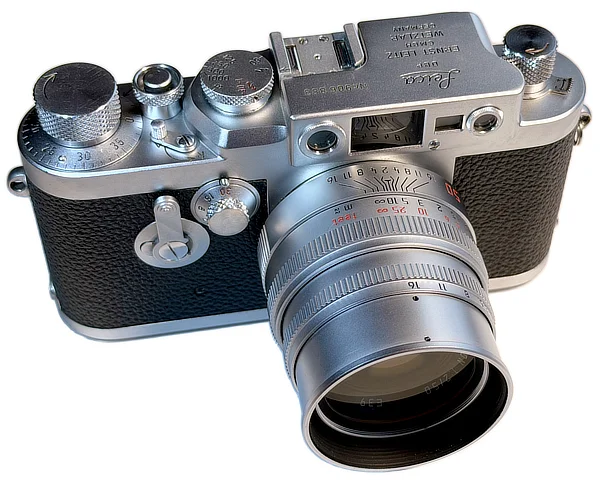
Using any Leica Thread Mount (LTM) camera is Quirks Mode all the way…
Honey, where are you going?
I’m going to load some film into my IIIG.
Will you be back before dinner?
Hopefully. Maybe.
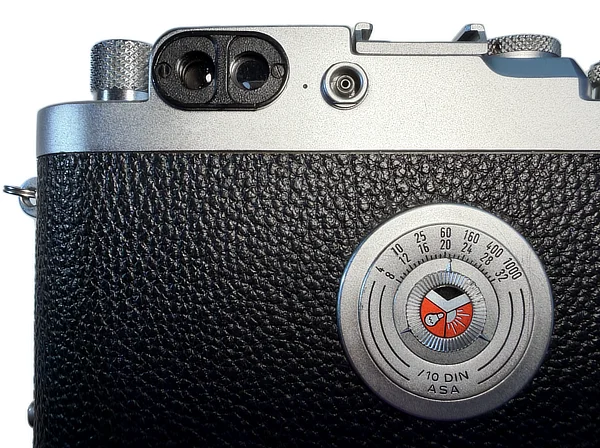
There is no hinged camera back, so after removing the baseplate you push your film into a separate uptake spindle then poke it through a narrow slit on the base. Many keep the shutter open at “B” so they can see what they are doing from the front, after unscrewing the lens of course. The film leader tongue also has to be longer than usual to avoid getting caught in the shutter. This “tongue” is easy to trim with an “ABLON” template, although many do it by hand. I also have a collection of “IXMOO” brass film cassettes (+ Bakelite film cannisters) which I custom–load using a Watson Model 100 bulk film loader, for that True Leica Experience™.
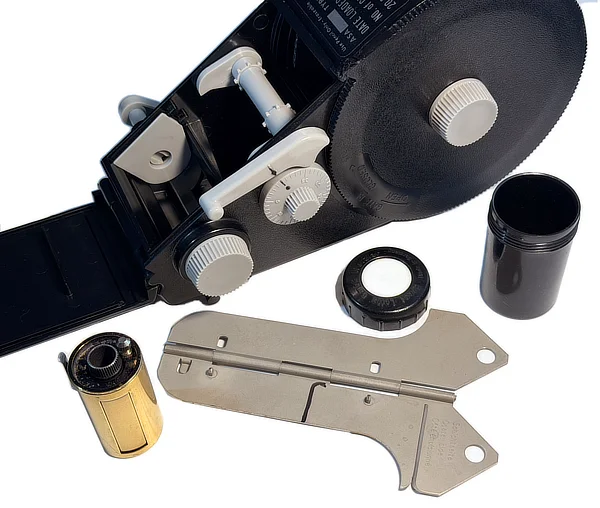
Got my IIIG in May 2015. A month later bought a 50mm Summicron M39 screw mount (11619) Japanese collector’s lens, to mix ‘n’ match old with new. Have been using the combo occasionally since, although it spends most of its time in a display cabinet now. It is incredibly fiddly to load and use, and having to swap between “standard” and “slow” s/speed dials is an anachronistic PITA. In mine the second shutter curtain has also become sluggish, occasionally leaving a narrow overexposed strip on a frame’s edge. Over years I have sent the camera to various international repairers (my IIIG has circled the globe multiple times), but no one can do anything as spare LTM parts have allegedly vanished.
Nevertheless the IIIG is a beautiful thing, a real icon of 1950s industrial design. But… I have better and more practical cameras, so on display it (mostly) stays. Luckily the rare LTM 50mm ‘cron can be reused on M–mount cameras via a 6-bit encoded Fotodiox LTM–M lens adapter ring.
Leica M6 TTL (0.85) ↑
Introduction
For years I avoided Leica M rangefinder cameras as I considered them overpriced toys for effete dilettantes wealthy enthusiasts. Yet I was so impressed by my Leica R6.2 that I began to wonder if there was something to the M hype. So in Feb 2000 I bought a cheap 2nd hand Leica M4–2 (10106) from ECS in Paddington. As I didn’t have any M lenses, they rummaged through a spare parts drawer and threw in a beater Summicron–M 50mm (11819) for $100 (which I still use in modified form as a loupe to examine films).
After a few rolls I was hooked. Sold the M4–2 to defray the cost of a new M6 TTL, then started acquiring better condition M lenses. A couple of years later I also got a M4–P and then a 1964 M3, both of which were sold when I went down the Hasselblad route and needed to (temporarily) reduce the GAS.
M6 TTL — one of a kind
The Leica M4-P worked fine, but found it workaday and uninspiring. It also lacked a built–in lightmeter. My late production M3 was legendary and very inspiring, especially since it had also been overhauled by Leica in Solms. Unfortunately the 1950s film loading scheme was finicky (and no, the “M2/ M3 Quickload Kit (14260)” didn’t help) and the 50/ 90mm viewfinder frustrating → see my Leica FAQ M3 entry.
Enter the chrome Leica M6 TTL 0.85 (10466), which I got new in July 2000.
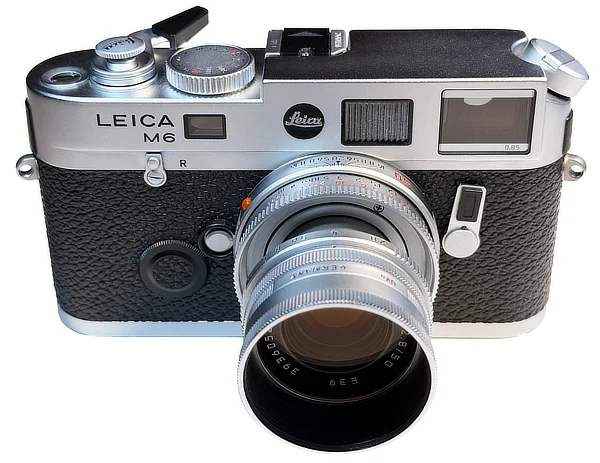
A few notes about the M6 TTL in the photo:
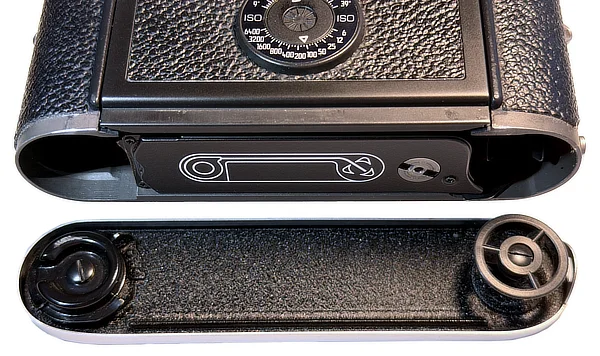
M6 TTL features/ use in detail?
There is already an excellent M6 TTL write up by “Emulsive”, so there is no need to reinvent the wheel.
Controversy Corner
Similar to the R8, the M6 TTL triggered a lot of feelings when it was released in 1998.
Oversized “Wrong way” shutter dial
The s/speed dial has a significantly larger diameter and rotates in an opposite direction to other Leica Ms. Many railed against this as they had been using their Ms for decades by pinching the smaller more elegant
s/speed dial, then turning it the “correct” way. Having to forgo decades of muscle memory to now turn in the opposite direction was needlessly distressing and cruel 😢
TTL at only 1/50th?
More precise flash control was welcome, but it was moot when it only worked with Leica’s underpowered units. X–sync also remained frustratingly slow at 1/50th, ruling out daylight use unless you stopped down to ƒ128 or had a stack of 6–stop ND filters. TTL turned out to be such a damp squib that it was quietly dropped after the Leica M7. Luckily they didn’t change the TTL protocol, so any M6 era flash will work with current Leicas (pay attention Sony…).
“Bloated” dimensions
The new TTL circuitry required more internal space, so 2.5mm was added to the camera’s height, visible by the larger gap between the rangefinder window and top plate. Many people lost their minds over this: They’ve ruined the timeless aesthetic of classic Ms!
“Flare prone” viewfinder
Online wisdom declared Leica was in financial trouble in the late 1990s, so had to skimp on M6 TTL viewfinder glass and coatings. Er, not quite. While the rangefinder focus patch may sometimes flare, under known conditions, it is an issue for all M models between the M3 and MP; see my Leica FAQ. BTW Leica’s financial woes actually peaked in 2004, when the company almost went bankrupt.
Zinc alloy instead of brass
The greatest amount of opprobrium was reserved for the retention of (lighter, cheap) zinc alloy for the camera top plate instead of reinstating (heavy, expensive) brass. Zinc had been implemented earlier for the Leica M6, to simplify manufacture and reduce weight, although it may have also made the housing more susceptible to cracking and corrosion. Online arguments about this raged at “New Coke” levels for years (Leica FAQ). In time the issue turned out to be overblown. After a few problems with early production M6s (eg. see this M6 with a bubbled cover), by 1990 they were resolved and my 1999 M6 TTL still looks and works like new. Yet Leica was so shell–shocked by the criticism that they reverted to using brass for subsequent M body shells, although to simplify production they were CNC machined instead of multi–step forged.
Things I like about the M6 TTL
The shutter speed dial
Yep. Its larger diameter makes it easy to rotate with your index finder while using the viewfinder. It also has a separate “Off” setting to preserve the battery, unlike previous models which use B for Bag
. I don’t care about it rotating the wrong way
. The larger dial was retained on the M7, but dropped thereafter due to persistent whining from collectors and very cross grandads.
The shutter
The amazingly quiet shutter is one of the main reasons for getting a Leica M. It is achieved in part by using curtains made from rubberised silk cloth. They are also very hard wearing. In my 27–year–old M6 TTL the curtains still look and function like new. There are also claims the shutter mechanism is so robust and under–sprung it can handle at least 400K actuations; see my Leica FAQ. There is a trade–off in that the shutter isn’t particularly accurate, with speeds being routinely out by ± ¼ EV, while the top “1/1000th” setting being aspirational only.
Fully Mechanical
It has internal steel gears to cope with motorised use, is fully mechanical and, aside from the lightmeter, is battery independent. As there is no automation to mess things up, this thing is built to last. It is also the final production M which allows use of Leica “IXMOO” brass film cassettes, provided you switch the baseplate. If you want to see how intricately complicated mechanical Leica Ms can be, see this 2026 Leica M4 restoration video (!)
Built–in Lightmeter
Light is measured by being reflected off a grey disc printed onto the shutter front curtain. Which is surprisingly effective as it averages out any scene contrast. Who needs Nikon F4 computer–controlled matrix metering
? The M6 TTL viewfinder display has also been upgraded by the addition of a central LED between two triangles to indicate correct exposure ▶ ● ◀ Only one arrow is lit during under/ over exposure, you then rotate the aperture ring or s/speed dial in the direction indicated until the 3–LED “bow tie” illuminates. BTW since there are no DX contacts in the film chamber, don’t forget to manually set the appropriate ISO value (!)
Choice of viewfinder magnifications
0.58 (for 28/ 35mm), 0.72 (general purpose) or 0.85 (for 50/ 75mm). I chose 0.85 as I mostly used 50mm lenses and it has the greatest rangefinder baseline separation for focus accuracy, which is important for shooting wide open at ƒ2 or beyond (eg. ƒ0.95 Noctilux).
Rare(ish)?
Apparently less than a 1000 silver chrome 0.85 were made, although no one is sure. Considering my simple modifications, I guess my particular M6 TTL is unique 🙃
CR1/3N Battery (+ alternatives)
The M6 TTL lightmeter requires a lithium 3V CR1/3N battery, which is becoming increasingly difficult to source. Not impossible (eg. Amazon), but not trivial either. In Apr 2024 I visited a host of Sydney CBD electrical/ hardware/ camera stores and left empty–handed; a few sales reps had never even heard of them… Eventually I found a couple at a specialist battery store on Sydney’s outskirts. Phew! When I vented to the sales rep he gave me a handy tip: they are commonly used in dog shock–collars now, so contact a pet store if things get desperate (!)
Alongside Leica film rangefinders from the M6 onwards, the CR1/3N is also used in the Nikon F2 and F3/T.
Instead of a single Lithium 3V CR1/3N, you can of course use a pair of silver–oxide 1.55V 357/ 303 watch button batteries (aka “SR44”). They are significantly easier to source and slightly cheaper at ≈ $AUD 13 a pair (eg. Bunnings), versus ≈ $AUD 20 for a single CR1/3N. The downside is they don’t last as long in the camera nor in storage (5 vs 10 years), nor work as well in cold/ freezing conditions. At a pinch cheaper alkaline–manganese 1.5V A76/ LR44 cells will also work, although I wouldn’t use them in precision instruments like cameras.
Rapidwinder
The Tom Abrahamsson Rapidwinder (“TAR”) is a trigger operated mechanical film advance which replaces the baseplate of those M cameras with internal steel gears & slotted motor cams (eg. M4–P onwards). It doesn’t work with older models (M4 and previous) since those cameras lack an internal motor cam and use softer brass gears.
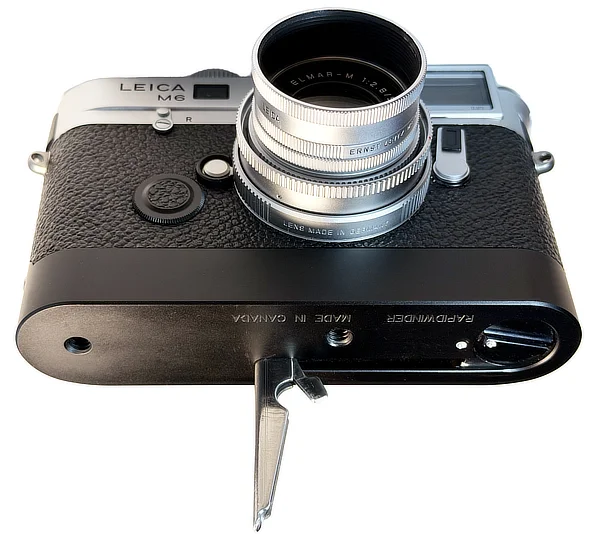
Think of the TAR as a manually operated motordrive, where you advance film by pulling laterally on the spring–loaded lever. You can only advance in one direction because the clutch disengages on the return stroke. You also have to separately press the shutter after each stroke, as you cannot hold it down while repeatedly pulling (yanking?) the trigger. You can however switch mid roll between using the TAR or camera advance lever without removing the camera base.
The TAR was so successful it “inspired” Leica to design their own version in 2003: the Leicavit M (14676). Yet the TAR was mechanically simpler, more reliable and cheaper: see the TAR website and my Leica FAQ.
Unfortunately Tom died in Jan 2017, so you can only get them 2nd hand now, at unconscionably inflated prices. I bought mine new in Oct 2001 and it is not for sale [ Note VIII ].
Leica Motor M
As mentioned earlier, I used a M4–P to shoot mainly 360° panoramas. With a 16mm full–frame fisheye lens this required a sequence of 8× frames to cover a full circle. Initially I advanced the film by hand, but after a few rolls got annoyed enough to buy a Leica Motor M (14408).
It is significantly more compact than the 1980s “Leica Winder M”, with two speed settings of “I” (1.5 FPS) and “II” (3 FPS). Neither is particularly loud, especially compared to a “Hasselpanzer” or Nikon MD-4 !
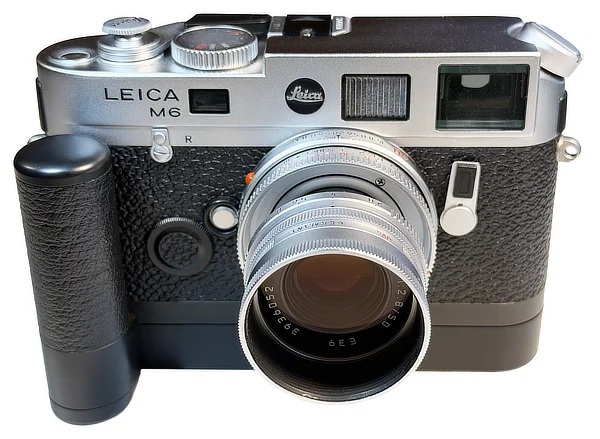
It uses a pair of 3V 123A batteries, and unlike the R8 winder or MD-4 motordrive, they do not power the lightmeter so you still need a CR1/3N in the camera body. This shouldn’t be surprising as there are no electrical connections between Motor M and camera. Similar to the “TAR”, the Motor M also allows manual film advance while the motor is still attached. Unfortunately it cannot rewind film, nor can it help with film loading, since you have to remove the motor to insert the cassette and leader into the take–up spool.
Worth it? Depends how much you shoot. The Motor M is fantastic if you hammer through rolls, but for occasional individual frames… not really. Again, see my Leica FAQ.

DIY Leather Wrap
When I first posted images of my leather wrap on a Leica forum in 2003, it attracted a lot of admiration: A case is like sticking a ‘car bra’ on the front of an otherwise beautiful sports car
… That’s the stupidest damn thing I have ever seen!
… Does it come with tatts, studs and a nose–ring?
… I would be ashamed to go out onto the street with such a ^%&#ing ugly thing!
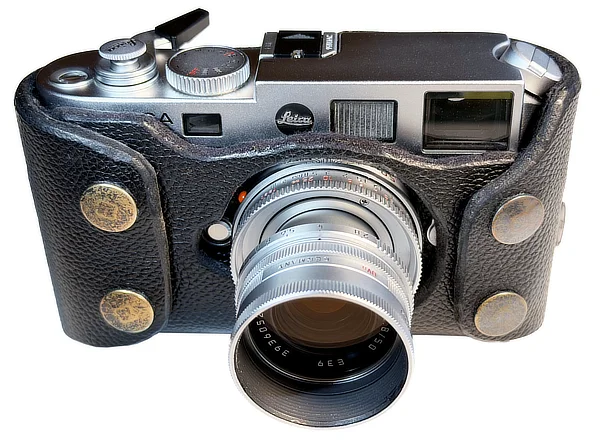
Unlike the bottom half of a Leica 14870 case, my wrap is made from a single piece of 5mm rolled surface pattern full grain leather hide, purchased from a tannery. It is lined internally with 2mm felt and held together by four brass press studs. At the rear I cut a 10mm hole for the viewfinder and added a vertical cable–tie with 2× Peak Design Strap Anchors. The leather was cut by (my) hand using electrician’s shears + an artist’s scalpel, then the edges were finished with a fine emery board and paint pen. The leather was treated with preserver then Dubbin. The photo above was taken in Nov 2025, 22–years after I made it. Like its maker it has aged rather well 😉
Rationale? Cheap; No need to fumble with a “never ready” case since the camera is always ready; It keeps greasy finger marks off the body; It helps protect the camera from scratches and bumps; It substantially muffles the shutter sound, although not as much as a dedicated blimp; Is soft, pliable, feels & smells (!) great.
Do I sell them? No. Can I send you a template? No.
I notice you can buy “Artisan & Artist” half–cases now, but they are significantly thinner so won’t muffle the shutter nor protect the body as effectively.
Leica M Accessories
Over decades I have found the following useful:
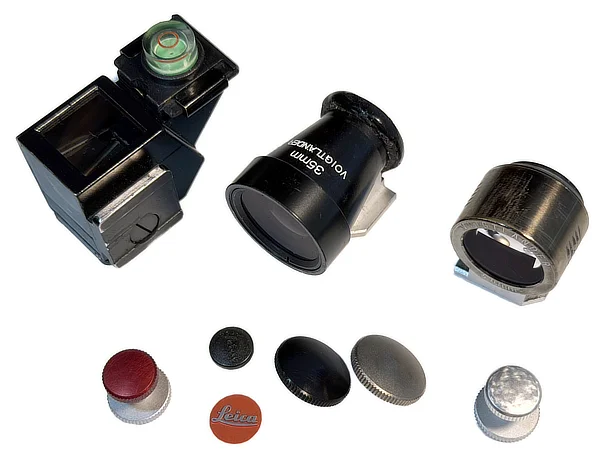
“AUFSU” finder
An accessory right–angle viewfinder made in the 1930–40s, which slides into the camera’s flash accessory shoe. It can be used in landscape or portrait format, and contains a tiny silvered pentaprism to display the scene right way up with correct lateral orientation. As you can imagine it is fantastic for candid shots, although I find the image rather small for Ol’ Man Eyes. I have added a hotshoe bubble level to help reduce “Dutch angles”. In recent years collectors have pushed up prices to ludicrous heights. More detail at my Leica FAQ.
Brightline Finders
I have two by Voigtländer: 35mm and 50mm (see YouTube video). They act as auxiliary viewfinders with (very) bright frame lines and are only useful for framing, as they don’t couple with the rangefinder. Again, see my Leica FAQ.
Abrahamsson “softies”
These were made by Tom Abrahamsson from 7000 series aluminium and (with great difficulty) anodised. From L to R in the photo: red mini, black chrome regular, titanium regular, silver chrome mini; the latter I buffed into a mother of pearl finish.
Flash sync terminal socket cap
You can get generic plastic versions for spare change. Original Leica versions are laughably expensive.
Leica “red dot” badge
In the early 2000s they were a spare part you could order directly from Leica as Badge circular ‘Leica’, 710 271 000 000
. They were (of course) expensive and I don’t know if they are still available.
Shooting with the M6 TTL
Since most of my work is digital now, I don’t use the M6 TTL anywhere near as much as I did twenty years ago. Even when I shoot film nowadays it’s mostly 120 medium format. I also prefer the Leica R9 or Nikon F5 for the (very) occasional roll of 135. Yet… there is nothing like working with a rangefinder camera. Maybe one day I will get a 2nd hand (digital) Leica M10–R (20003). Maybe. One day…
PN&T — Parts 2 & 3
Next → Part 2: Film, filters, lighting & lightmeters
Last → Part 3: Digital cameras & photography
Copyright — All Rights Reserved ↑
Unless noted otherwise, everything in this article is and remains the sole copyright of its Australian author.
Although you are permitted to view this material online, no other use, reproduction or implied license is allowed without the author’s prior written consent.
The internet may still be free, but intellectual property is not.
Notes ↑
Original Version 6 February 2026 — all rights reserved