PN&T 2 — Film, Filters & Lighting
Photography Now & Then
(PN&T) is a personal journey about cameras, lenses, films and digital imaging I have used since 1980.
(When citing this article, please use photonat.4020.net
)
| Topic | Description |
|---|---|
| Shooting Film | Film & processing for B&W, K–14, E–6 and C–41 |
| Lens Filters | Using filters for B&W and colour — film or digital |
| Gossen lightmeters | Incident/ flashmeters: Luna–Pro F, Sixtomat Flash & Digipro F |
| Working with Flash | Studio strobes, camera TTL, compact manual flashes, exposure metering & continuous tungsten/ LED |
| Stories | Greta Garbo II |
Overview
Photography Now & Then
was originally a single article, but has since been split into three sections:
- Part 1 — Film cameras
- [ link ] Nikon & Leica 35mm cameras, Hasselblad & Mamiya 120 medium format
- Part 2 — Film, Filters & Accessories
- [ link ] B&W negative, colour transparency and negatives; Film processing; Lens filters; Hand–held lightmeters; Flash & continuous lighting
- Part 3 — Digital Cameras & Photography
- [ link ] Sony & Leica mirrorless cameras; Digital workflow, issues, impact of A.I.; The importance of your own website
Working With Film
Film capture has undergone a renaissance from 2015 onwards. Not only are the cameras (generally) simple and compact, but they are also great fun to use. Improvements in scanning technology has meant 24MP (or higher) resolution scans which can produce fantastic quality screen or print images.
Section Quick Links
- Why film?
- B&W vs. Colour
- B&W negative films
- B&W film processing
- Colour reversal films
- Colour negative films
Rationale ↑
Most of my work now is digital, yet I still occasionally shoot film. Not so much for a retro film–look aesthetic
, but simply because I enjoy using film–era cameras.
With older mechanical cameras there is no forest of menu options. No chasing the focus point around the EVF. No nose–activated hyperactive touchscreen. No AEL. No half–remembering which dial does what. No continuously draining battery (ahem, aside from the Nikon F3/T). No beeping audio feedback you have to drill twenty levels down to silence. You get a clean, simple haptic interface. Clearly marked aperture ring and s/speed dial (on the Leica IIIG you get two). A clear viewfinder with manual focus aids. You measure the light, set the aperture and s/speed, focus, wait for the right moment and take the bloody shot.
It saddens me few digital camera makers can bring themselves to understand this and instead insist on varying amounts of automation to make things “easier”. FFS. If you wish to use digital cameras with manual only control, then your only options are luxe offerings from either Fuji or Leica (I’m looking at you M11–P…)
Yet film has one other benefit I suspect will eventually bite most digital users — archivability. In 2023 I set about high resolution rescanning my favourite shots from the 1980s & 1990s. Some of the films were more than 40 years old, but due to careful processing, storage — and luck — the films were still in excellent condition and the resulting 40MP scans look spectacular. I extracted tones and details I had never seen before, while I’m certain no one is going to be extracting anything from RAW digital files in forty years time…
To be clear I do not miss the downsides of film like the forever–increasing expense or sweating in a “dankroom” or engaging in photochemical warfare when mixing solutions or rocking trays. Nor do I miss having to retouch scratches and dozens of ^%&#ing dust spots. Even today, working with film requires far too much guesswork and finger crossing. Development remains a PITA (Why won’t this damn film slide into the processing reel?
Is the developer still okay?
Is the fixer exhausted?
Crap, the negatives are too thin — the solution must have cooled during development
). So aside from developer or toner fumes, I’m not misty eyed about any of this and, to be honest, nostalgia only works if you have a faulty memory.
As a result, I now use film as merely a first step in an otherwise digital process.
While completing this article in Feb 2026, film prices increased by ≈17% due in part to a speculative bubble in silver bullion & futures contracts. Good and bad news. The bad is obvious → more $s per frame. The good is it will force everyone to do what I’ve been saying all along — make every shot count.
B&W vs. Colour ↑
I have written about this already in my Critics
essay, so I’ll keep it short.
You see the world in colour, why not record what you see? B&W is an obsolescent medium invented only because colour technology was not available at the time.
That said, I appreciate the abstraction (and processing simplicity) of B&W. Most images work in colour, some in B&W, and despite self–righteous grandstanding informed discussion in online forums, the requirement to shoot exclusively in B&W to capture people’s souls
does not in my universe constitute the Eleventh Commandment.
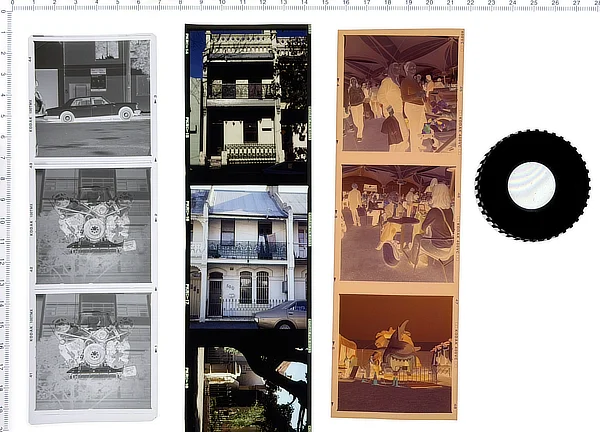
Black & White Film ↑
Over decades I have tried a large variety of B&W films, but have settled on only 2–3 for current use. For 120 medium format I prefer Kodak TMAX–100. In the Eighties & Nineties I used to be a huge fan of Ilford films and papers (and still use their Perceptol & Hypam darkroom chemicals), but over time found their FP4+ and later Delta 100 emulsions too grainy in comparison to TMAX–100.
If I need something faster then I opt for 400 ISO Kodak TMAX-400. I tried Ilford HP5 a few times, but again found it too noisy for my taste. Back in the 1980s I used to push–process Kodak Tri–X to 1600–3200 ISO, but with vastly superior digital capture there is no longer any need.
I face a conundrum for 135 format in that results will always be grainy no matter what you do. This is due to the greater enlargement ratios required by the smaller frame size (“135” = 24×36mm vs. “6×6” = 56×56mm or “6×7” = 56×69mm). I have tried 135 versions of 100 ISO Ilford 100 Delta Professional and Kodak TMAX–100, but was never satisfied. In the 1990s I used Kodak Technical Pan 2415, which was amazing but slow (25 ISO), red sensitive (great for skin tones but would lighten lipstick & nail varnish) and required a special developer. It was however exceptionally fine–grained and sharp, yielding impressive 40MP scans decades later. Unfortunately it was discontinued in 2004 due to its stiff “Estar-AH” base, which tended to jam in motor–driven cameras or when being fed into auto–load developer reels.
In March 2026 Kodak replaced their TMAX range of B&W films with EKTAPAN. The new film inherits the T–Grain emulsion used in the original TMAX line, so it seems to be more of a rebranding exercise than reformulation. Time will tell.
As mentioned before I mostly shoot 120 medium format now, so a lack of satisfactory 35mm options isn’t too limiting. But never say never. In Dec 2025 I started experimenting with Ilford Pan F Plus. At only 50 ISO it is s–l–o–w, especially with a −2 EV orange filter, but initial results are promising albeit not incredibly better than Kodak TMAX–100 🤔
I tend to buy film in 100–foot rolls or multi–pack lots, then store it in a freezer at −18°C in their original packages. My freezer has a shallow middle tray which is ideal for this:
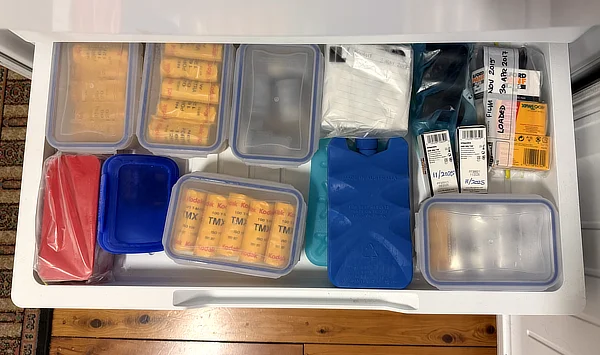
Unopened film is thawed for 2–3 hours before use to prevent condensation on the film surface. Kodak have a Technical Information Bulletin about this: Storage and Handling of Unprocessed Film
(2022). See also their Storage and Care of Kodak Photographic Materials
(2017) for tips on archival storage.
B&W Processing
To my amazement a lot of photographers outsource this to labs or friends or random people they meet on the dance floor. Not. Me. As far as I am concerned, choosing the right film + filter + lens + camera is only part of the equation, making the little Ag granules snap to attention is the remainder.
Ceaseless experimentation in the early Nineties has yielded the following:
Development
Ilford Perceptol at 1+1 dilution. Perceptol for the fine grain and 1+1 dilution for greater temperature control and acutance. It is a one–shot process so you discard the solution after use, which guarantees fresh developer every time. One litre of full–strength concentrate is enough for four 120 or 135 format films. I tried 1+3 dilution once, but it exaggerated acutance so much it overwhelmed the film’s grain structure. The necessary increase in development time was also ridiculous (≈20 minutes).
Figuring out the correct development time(s) for each film used be difficult, but it is much easier now. Look up your film at the Ilford Films colour development chart or The Massive Dev Chart database, then apply temperature time corrections using the Ilford Temperature Compensation Chart.
I have done this for my favourite films, then created an Excel spreadsheet + PDF chart I display on my iPad during development:
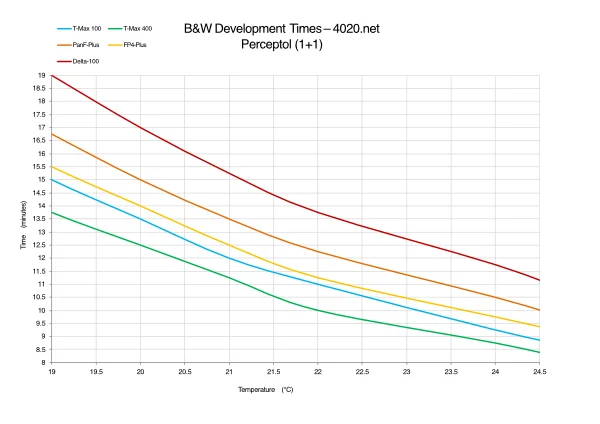
The same development technique is used for every B&W film:
- Pre–wash for 2 minutes in plain water at the desired temperature to get everything thermally equilibrated — for 120 rollfilm it will also wash off the film anti–halation rear layer
- Pour in developer, start the clock, aggressively tap the tank to dislodge air bubbles and give 30 seconds initial agitation, followed by 5s every 30
- A spindle is used for rotary agitation instead of the more common inversion method
- I try to maintain the solution temperature at 21–22°C, although keeping it there in winter can be a challenge
I have used various Patterson daylight tanks since 1981, but in 2016 replaced the Patterson film reels with a pair of Omega alternatives. These have longer film guides which make them easier to load, especially with curly 120 film. (BTW it helps if you round off the film leader corners before feeding into a reel.)
Stop bath
Among other things I am an ex-industrial chemist, so I use ≈ 1ml of glacial acetic acid in 500ml water, which is enough to stop a freight train let alone developer. For LOLs I once tried a couple of drops of oleum, which worked fine but was a bit maxtreme even for me. Those who frighten easily can instead use a splash of vinegar or (quelle horreur) a commercial stop bath.
Fixer
This one is easy: Ilford Hypam at 1+5 dilution. Slosh it around for 4–5 minutes and pour it back into the storage bottle to be reused. A litre of diluted solution is adequate for ≤ five rolls.
Wash
Twenty years ago I added hardening agent to the fixer to reduce scratches and improve drying times. The downside was having to wash for 60 mins in running water. As I no longer do this, 30 mins of running water is enough. A gentle flow of 2L/min is adequate, just enough to flush residual chems off the film and out of the tank. Yes it’s a waste of water…
Drying
It required a lot of voodoo to get this right. Fill the tank with warm water at ≈ 45°C, add 5 drops of Kodak Professional Wetting Agent 200 and agitate to get a nice foam. Don’t use too much wetting agent as it will leave bubble impressions on the dried film (!) Then hang the film to dry with weighted s/steel clips. Do not squeegee excess water — let it trickle off. Since the surfactant solution is quite warm, its surface tension is low enough for the solution to run off without any leaving drops or residue. Hang the film in quiet room and wait ≈ 4 hours to air dry. Once for LOLs I hung my film out to dry on a windy day with the laundry on the backyard clothesline. It dried super fast, but the amount of dust/ pollen/ dog hairs (saliva?) adhered to the film was a bit excessive.
Storage
The processed 120 films are cut into strips and stored in Print File Archival Storage Page sleeves. Which really are archival as I have films which have been stored this way for 40 years without deterioration.
“Keeper” shots on 135 film are cut into individual frames and mounted in glassless GEPE plastic slide mounts. These don’t seem to be made anymore, although similar alternatives are easily available.
Digitising
I still occasionally use an antiquated Epson Perfection V700 scanner with VueScan software, but from 2024 onwards have been digitising my films using a home–made digital camera copy rig. Since there are plenty of articles and videos about this already — Google it mate
.
Colour Reversal Film ↑
When I started shooting colour in the 1980s, I initially used C–41 negative film. It was relatively cheap, easily available and there were minilabs everywhere for quick & inexpensive processing. Unfortunately the convenience ended there, as I had a nightmare of a time getting decent quality prints.
The problem was you couldn’t determine colours by merely inspecting the (orange masked) negative. Which opened the door to lousy guesswork from disengaged (colour blind?) lab technicians. High–volume wedding and portrait photographers worked around it by setting up their own RA4 print machines to get prints done to their requirements with reasonable colour fidelity. Not an option for us little guys.
I found had to photograph a colour test target at the beginning of every C–41 roll, with standard RGB and CMYK elements, for lab technicians to pretend to use. Part of the reason Polaroid proof–prints were so popular back then was to provide colour images to help guide our visually impaired “Pro Lab” friends.
Enter Plan B, colour reversal film. Aka “transparencies” or “slides”. No more guesswork — WYFSIWYFG. There in front of you was a master image with all the colours exactly the way you want. No more arguments 💕
Reversal film solved the colour fidelity issue because you placed the original onto a calibrated lightbox and kept adjusting the scanner or printer CMYK settings until the two (reasonably) matched. In the pre digital era this explains why magazines and advertisers only accepted images on reversal film (or at a stretch hard–copy prints).
Restricted Dynamic Range (D/R)
Only 5 ƒ–stops at best. Ignore assertions it has 8, or even 12 ƒ–stops exposure latitude (eg. for Kodachrome 25). These are best–case scenarios from lab density measurements, not real world images. The adage of expose for the highlights and let the shadows fall where they may
came from shooting slide film. Highlights would routinely blow out, shadows got unfathomably dark. Some people liked it, others built their careers upon it (eg. Alex Webb) — but I found it frustrating. You had to use fill flash, scrims and/ or reflector boards for just about everything, indoors or out.
Mixed lighting/ Mixed results
The greatest issue with reversal film though is being unable to cope with artificial light without colour correction (CC) filters, as there is no AWB when shooting film. Since there is no such thing as “objective” colour [ Note II ], film chemistry can only record what was actually there and not what our minds “saw”. So light from fluorescent “daylight” tubes is recorded as emerald–green, while tungsten filament light–bulbs are rendered yellow–orange, despite our minds reporting “white” for both. When artificial light is mixed with natural light, colours can run riot — see the Dean Stockwell Camelot service station scene in Paris Texas (1984) or Alex Webb’s A City of a Hundred Names
(2001).
An 80B (blue) filter will tone down tungsten orange, while a CC30M (magenta) counters fluorescent green — yet more stuff to carry around. CC filters also absorb light and thus reduce the effective ISO, requiring longer exposures. Cinematographers don’t muck around, instead of filtering the lens they gel all the light sources with CC filter sheets and adjust until they have exactly the colour they want. Not really an option for “run–and–gun” candid street photography…
FWIW when shooting indoors I always use a faint blue 80C filter to boost the blue channel
Transparency films came in two broadly different types based on their processing chemistry: K–14 and E–6:
Kodachrome (K–14)
Kodachrome was a magnificent film. Don’t be fooled by lousy online scans of shots from the 1940s and 50s, as colour images from this film were made to last. I have shots from the early 1980s which look like they were taken yesterday — no fading, yellowing or red dye “cyanification”. Because there were no dye–couplers in the film structure, it had fewer layers, making it thinner and consequently sharper than any other colour film — an important feature when shooting onto small formats like 135.
The resulting colour was also fantastic. Neutral but with a bit of saturation to make things pop. Kodachrome 64 (64 ISO) was good for general use, with Kodachrome 25 (25 ISO) for hyper–sharp sunny landscapes. Kodachrome 200 (200 ISO) was also available near the end, but I found it boring compared to K64.
So what’s not to like?…
Strong contrast
As mentioned earlier, reversal film had limited dynamic range so was predisposed to be contrasty. Kodachrome took it to the next level. You worked around it by exposing for the highlights, but occasionally you wanted to see what was also going on in the shadows, right? Thus a reflector card and/or fill–flash was nearly mandatory, despite 35mm cameras having slow sync speeds [ Note I ].
Limited formats
For a long time Kodachrome was only available as 135 rolls, with 120 medium format (eg. PKR–6033) only introduced in the late ‘80s and even then discontinued a decade later.
Limited Processing
K–14 was such a complex and toxic process that, outside of the USA, each country had only one centralised facility. In Australia it was at the Kodak factory at Coburg outside Melbourne. For anyone who didn’t live nearby, this meant relying on the postal service to transit film across the country. Two week turnaround times from Sydney were not uncommon. Neither were lost films. Towards the end the Coburg plant closed and film then had to be sent to the next closest facility… in South Africa.
Slide Mounts Only?
Processed Kodachrome was mounted by default as individual frames in cardboard (or for a while plastic) slide mounts. Few people realised you could request film be returned uncut in a single roll, by clipping the mysterious envelope dashed corner off the yellow prepaid film mailer.
End of an Era
Kodachrome was already rare in the late Nineties, but somehow managed to linger for a few more years until it was discontinued in 2009.
-

This K64 shot of Franklin Dam protesters in Feb 1983 still looks new. Notice the murky shadows due to the film’s limited D/R
Ektachrome (E–6)
Kodachrome’s turnaround times in Australia were brutal. As was its high contrast and any size you like so long as it’s 35mm
limited format. Commercial photographers typically worked with large format film — 120, 4×5 or even 10×8 inches — so Kodachrome was out. Wedding/ portrait photographers mostly shot C–41 due to its broad exposure latitude and rapid processing/ print times, especially if they were busy enough to warrant their own minilab.
Due to the publishing/ reproduction demands of magazines and advertising clients, commercial photographers had no choice other than shooting colour transparency film. Yet they also needed a range of film formats + rapid turnaround times…
Enter E6 Ektachrome.
Kodachrome’s Poor Cousin?
Until the mid 1980s, correct. The release of Ektachrome 64 in 1976 didn’t fool anyone, but it was available in a range of sizes and got the job done. E6 films eventually came of age in 1988 with the release of EPP–100 (Kodak Ektachrome Plus Professional 100 (6005)
). It was reasonably sharp (see below), had excellent colour and fine grain. Surprisingly it also turned out to be quite stable — I have EPP–100 shots from the early Nineties which still look great (!)
Fast local processing
This was E6’s trump card: you could get it done in a couple of hours at Professional Labs dotted around Sydney. I used to used Vision Graphics at North Sydney, then moved on to Visual Image Lab in Redfern. Am amazed both are still in business, although a third lab I used at Holt Street Surry Hills seems to have disappeared.
A range of film varieties
Not only in different film sizes, but a variety of E6 film types, ISOs and different manufacturers. In the Nineties Fujichrome Velvia 50 was immensely popular, especially for those who liked their colour saturation at “11”. I detested it and wryly note its 1–stop faster cousin Fujichrome Velvia 100 was not only toxic aesthetically but chemically as well.
Tungsten Balanced options
Ektachrome 64T meant you didn’t have to monkey around with 80B CC filters. Tried it a few times and hated it, but at least the option was there.
Sharpness?
Nup. Kodachrome was king, although EPP-100 kinda got close. The main issues were all the extra layers of colour couplers in E6 film structure, which Kodachrome eschewed. Part of the reason professionals shot onto larger format films (120, 4×5 etc.) was to reduce enlargement ratios and thus minimise the impact of E6 film’s inherent blurriness.
DIY processing
Yes! You could buy kits to develop E6 film in a standard daylight tank. I did it once in 1981 with a 12–step E6 process, which was painful enough to never do again.
Digitising
Digitising transparency film is relatively straightforward. You have the original for reference and can easily tweak your scan to match. Furthermore if you digitise using a camera, you can use the camera’s built–in AWB to ballpark the colours.
After an initial “scan” I can get a good colour match in about ten minutes and exact within thirty. With C-41 and its ^%&#ing orange mask, even with years of practice, it can take hours to get things right.
Colour Negative Film (C–41) ↑
Films
In the 1990s and early 2000s I shot kilometres of this stuff, both in 135 and 120 formats. It has a tremendous exposure latitude of at least 12 stops, fine grain and, unlike E6 transparency films, is sharp. It is also far more forgiving of mixing daylight with artificial light.
In 120 medium format I prefer Kodak Portra VC 160. Great skin tones, sharpness and fine grain. I still have a batch of sixteen 120 rolls in my freezer, despite expiring in 2013. I sometimes shoot a test roll and it (amazingly) still works okay.
The 135 format films I used in the early 2000s are no longer made (eg. Kodak Supra 200). The current Kodak Eastman GOLD 200 should work alright, while Cinestill films are also generating a lot of buzz.
In March 2026 Kodak replaced their PORTRA range of films with EKTACOLR. Like their new B&W EKTAPAN film, EKTACOLOR seems to be more of a rebranding exercise than anything novel.
Processing
C–41 film used to be easy and cheap to get processed, as every shopping centre had a Nortisu or Fujitsu minilab. Because I got 5–6 (135) films developed each week, I soon befriended a couple of owners and they would put my films through in less than an hour. For 120 film I had to use pro labs in the CBD, whose turnaround times were 3–4 hours, or 1–2 days if you weren’t in a hurry and wanted to save a few dollars.
That was then. C–41 labs still exist, but you have to hunt around and be prepared to wait. Best options are via better photography stores — eg. Sydney Super8 in Newtown — but there are others (try the E6 pro lab links above).
DIY home processing is another alternative. In 2013 I bought six Tetenal C–41 Press Kits but never used them as I was wary of the strict ±0.1°C development requirement. Likewise the very limited shelf–life for solution once mixed. Since at the time C–41 processing was still easy to get done at suburban minilabs, I couldn’t be bothered tinkering at home. (Still have the unopened Tetenal kit packs. Wonder if they work after thirteen years?…)
Snafus
The killjoy for C–41 film is its orange mask base. I acknowledge it was done to compensate for imperfect CMY dyes and because original paper stocks couldn’t handle the contrast range of colour films. Fair enough but come on, most people digitise this stuff now and the orange mask screws everything up. For good measure, different C–41 films use differently tinted orange masks, crippling your ability to standardise a software workflow [ Note III ].
Scanning software, eg. VueScan or FilmLab, will do most of the heavy lifting, but you still have to fine–tune the RGB forever. Since my preferred RAW editor only grudgingly implemented C–41 support in March 2026, there was no alternative to converting C–41 “scans” other than laboriously by angry fists banging on the table hand.
Profile support or not, when digitising C–41 film you need to set aside at least an hour to manually adjust/ tweak/ voodoo the RGB balance. Then add another age to spot–retouch every dust spot and tiny little hair. For every single image…
-

It can take forever to get C–41 colours “right”, but at least it has an extensive D/R. Reversal film here would have completely blown out the skies
Lens Filters
Introduction
These have fallen out of favour in the last couple of decades. Which is understandable as they are expensive and a lot of the effects they provide can now be easily achieved in post, either in a RAW or Photo editor.
Yet I still use them, especially for B&W photography. UV protection filters are also practical and indeed have saved two of my lenses from expensive (perhaps irreparable) damage.
One major caveat though, aside from UV/ Haze filters they all absorb light, resulting in longer exposures. For Neutral Density (ND) filters this is the point, but for others it can be a nuisance.
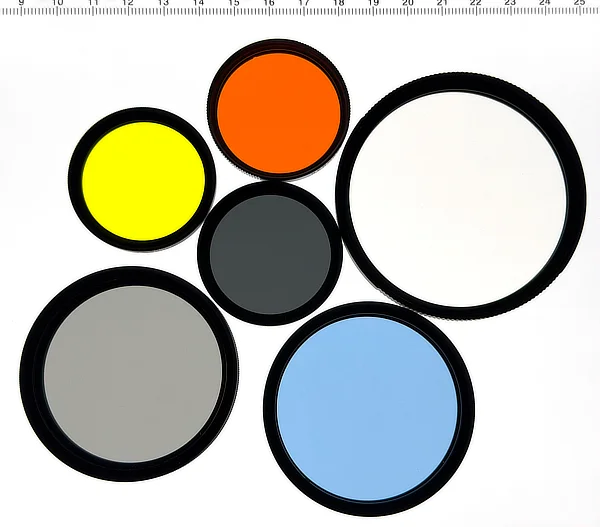
Filter Notes ↑
Orange
These significantly darken blue skies for B&W shots. Not as dramatically as with a red filter, but a notable step up from yellow. They typically have a 4× filter–factor, so you need to increase exposure by 2 stops (eg. ƒ8 instead of ƒ16). They are also useful for colour work during sunsets, although on digital cameras it’s a good idea to dial back the effect using the “custom colour temperature (K)” White Balance option.
Yellow
For B&W these darken blue skies and green foliage, although not as much as orange. They also lighten skin, which can otherwise end up too grey. They are great for general purpose B&W and I always have one on each of my Mamiya C330 TLR lenses. They have a 2× filter–factor, so you need to increase exposure by 1 stop.
UV/ Skylight/ Haze
Their original purpose was to reduce bluish haze in distant landscapes, as film can sometimes be overly sensitive to UV. Now with digital they are mainly used to protect the lens front element from spills, sparks, shanks, accidents etc. I have nearly indestructible UV filters by Aurora Aperture made from Gorilla Glass for most of my full–frame lenses, although I don’t use them on my Hasselblad nor Leica R macro lenses as their front elements are deeply recessed and therefore adequately protected.
Neutral Density (ND)
Want to shoot at ƒ2 in bright sunlight? ND filters to the rescue. Video shooters also use them to reduce light intensity to follow the “180° shutter rule” and shoot in bright light at only 1/50th. I have two 4–stop NDs in different sizes (E39 and 67mm), the former for Leica M lenses and the latter for various Leica R lenses and my SEL1655 APS–C zoom.
I should mention graduated ND filters. These are mainly used to darken skies, where the upper part is a ND filter but then tapers to clear about half way down. In practice I have found the ND portion of these things can deliver a different colour to the clear portion, particularly a magenta cast to cloudy skies (URTH claim to have solved this). Frankly I haven’t used graduated filters for years because you are better off darkening skies in post.
Polarising
Years ago I used P/L filters all the time for colour (film) work, but rarely do so now. Their main purpose was to reduce reflections from smooth surfaces like glass or marble, along with darkening blue skies. Unfortunately they also reduce reflections off skin, resulting in bizarre suede effects. Likewise water bodies at certain angles can end up looking weird. Then sometimes the sun is in the wrong part of the sky, resulting in minimal if any darkening. As for Circular vs. Linear polarisers: the former are required by cameras with semi-silvered mirrors or beam splitters (DSLRs, Sony SLT), while the latter work on everything else. It’s a moot point though as nearly all P/L filters sold now are circular.
Colour Correction (CC)
These are white balance correction filters to shift the light temperature. 80 (A,B,C) is for blue/ cooling and 85 (A,B,C) for amber/ warming, with FL–Day to correct fluorescent. Putting on my physics teacher hat, the blue filters increase colour temperature while the red ones lower it. Hoya have given their CC filters different names but they are same thing. Many argue they are redundant now for digital cameras with AWB and I mostly agree. But if you know you will be shooting under (say) fluorescent light, you can nail the colour balance if you use a FL–Day filter to assist the camera. Likewise a faint 85C when shooting under LEDs is handy to dial down the blue–heavy spectrum.
Close–up lens
Eg. a Sigma AML72-01 which provides 1:2 magnification (≈1.75 dioptre). It has a 72mm thread but with step up/down rings can fit (almost) any lens. I use one on my SEL1655G whenever I need to get close(r) but haven’t packed a macro lens. These close–up filters used to have very poor reputations (ahem, aside from the specialised Leica ELPRO 1:2–1:1 Near Focus Attachment (16545)), but the “AML72-01” is surprising good, plus cheap enough to not worry about getting lost or scratched. Indeed my NiSi 67→72mm step up ring cost twice as much as the filter [ Note V ].
Soft focus
These are a complete waste of money. Get a cheap UV filter and apply Vaseline. In my case I stretch (and I mean really stretch) black stocking material over the front of a lens. Black fishnet also works for a more subtle effect. This is for when you wish to soften things during in the shoot, otherwise it’s easier to create the effect in post using a Photo editor.
Gossen Lightmeters
I have used the following hand–held lightmeters over the last 35 years. They are all German–made by Gossen and have never let me down. In the late Nineties I flirted with Sekonic and Minolta alternatives, but found them either too cheap (S) or fiddly and expensive (M).
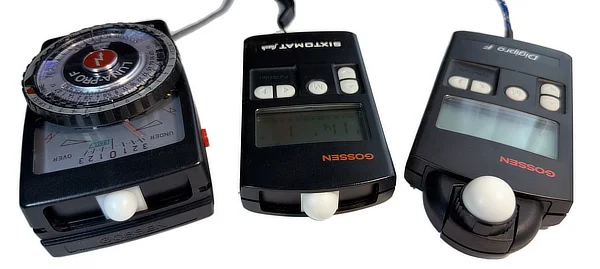
All three Gossens support flash and EV scale readings, which dovetail nicely with EV settings on Zeiss Hasselblad lenses.
Section Quick Links
Measuring Exposure ↑
There are two ways of measuring light when estimating photographic exposure : “reflected” & “incident”. “Reflected” is done by every TTL camera where light goes through the lens and electronic sensors within the camera figure out the aperture and s/speed with reference to the ISO. Alternatively for “incident”, you use a separate hand–held meter to measure the amount of light falling onto a scene.
Reflected readings are fast and convenient as they are built into cameras. The problem is they all assume a scene’s average reflectance is 18% grey, which it seldom is — especially if it is predominantly black or white. Reflected readings will thus always be messed up for photos on the beach or on snowy hillsides, 3D Color matrix meter with 1005-pixel RGB sensor
or not.
With digital cameras you can immediately see if the exposure is out and adjust accordingly, but with film you have to guess (and hope). Hence the reason pros shot a lot of Polaroid instant prints in the Eighties & Nineties, to get the exposure right before to recording onto film (which was expensive even back then).
Incident readings cannot be fooled by a scene’s colour or contrast, as they directly measure the light intensity falling onto a scene. To do this you need a hand–held meter then stand in front of the scene/ person/ object you need to measure.
As a result incident readings are nearly always accurate, although they don’t work so well for fast action or long telephoto shots. In which case you need to revert to reflected readings and compensate (and hope). Many people use spotmeters, but despite being more precise they still suffer from measuring reflected light.
Even today I still pack a hand–held meter for occasional incident readings. With digital it isn’t strictly necessary, but call me old school. It is however essential for metering flash photos.
Luna–Pro F ↑
In 1982 my first proper lightmeter was a 2nd hand 1960s Gossen Lunasix 3. It worked well for daylight but couldn’t measure flash, forcing me to rely on dodgy G/N calculations or built–in flash auto–thyristor control.
In 1990 I finally got fed up with the workarounds and replaced the Lunasix 3 with a decent flashmeter — a 2nd hand 1980s Luna–Pro F:
- All exposures were spot–on thereafter 🎉 😀
- It measures daylight and flash, or any combination thereof
- Uses a PP3 9V battery, which lasts forever with a Lithium 1200 mAh cell
- The film–speed dial is still in “ASA”, as “ISO” was only introduced in 1987
- Mine is the
Luna–Pro F
, but it was also sold as theLunasix F
- I mostly use it in incident mode, although its spherical white diffuser can be slid out of the way for reflected readings
- In 1992 its retail price was $AUD 695 ($1655 in today’s money), hence the reason for buying 2nd hand!
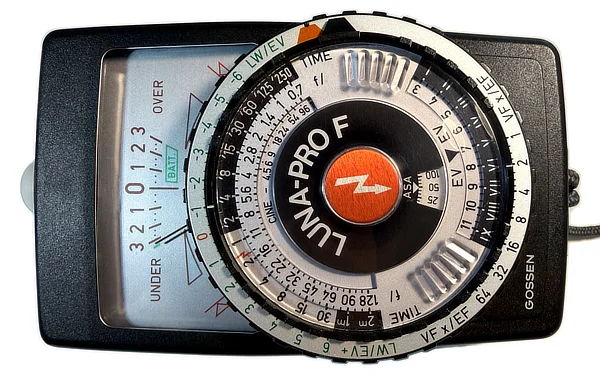
I sold it after a few years when upgrading to a Sixtomat Flash (see below), but missed the retro dial so much I bought another in Mar 2017. I continue to use it for 120–format B&W, but the tiny aperture and s/speed numbers are difficult to read now without glasses 🔍
Being an ‘80s relic with an analogue needle + magnetic coil + 9V battery, it is a bit bulky, which can make pocket storage awkward…
I originally wanted a Profisix SBC. It had an extensive range of accessories and was claimed to be the most professional of Pro
lightmeters. Ironically for flash use, the Luna–Pro F was a better option as it already had flash functionality built in, whereas a separate “Profi FLASH” attachment was required for the Profisix.
Sixtomat Flash ↑
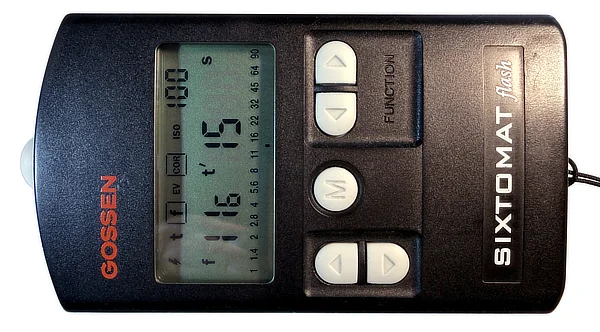
Bought this to replace the Luna–Pro F since it was thinner and solid–state with no fragile moving parts. Of all my lightmeters the Sixtomat Flash has seen the most use, having measured 10Ks scenes over twenty years. Like the Luna–Pro F it can measure ambient or flash or any combination thereof.
Despite its all–plastic build, it’s a robust thing with an easy to read display (without glasses!). It uses a single AA 1.5V battery which in Lithium 3000 mAh format lasts years. My only issues are having to hold the meter horizontally when doing measurements and the white diffuser sphere being a bit small.
Gossen make an updated “F2” version with red buttons and a few additional markings, but I haven’t bothered upgrading as it’s basically the same meter.
Digipro F ↑
Around 2010 I was looking to upgrade from the “Sixtomat F” so got the Digipro F. Frankly it’s not much different and also uses single 1.5V AA battery, although the ball head is much larger and can swivel fore and aft.
What I like is being able to use it vertically to easily read exposure values during measurement. What is annoying is the swivelling ball–head which sticks out the top, making it considerably longer than the Sixtomat. What I hate is having to unscrew the ball diffuser when doing reflected readings (with either the Luna–Pro or Sixtomat–Flash you slide the ball out of the way).
Again there is an updated “F2” version, with black buttons, red & white livery and a few additional fringe features. Again I haven’t bothered upgrading.
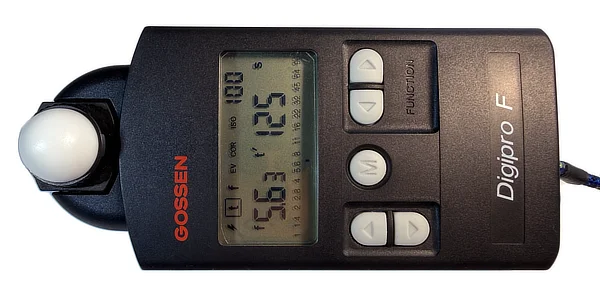
Most of the time I use the Sixtomat–Flash for everyday stuff, or the retro Luna–Pro F for B&W film. The Digipro F is mainly used for flash exposures due to its larger ball–head and vertical display.
Working with Flash
Lighting photographs is a huge topic, so I will stick to a few things I have learned over years and will write a separate essay later. Maybe.
Section Quick Links
- Studio strobes
- Camera TTL flash
- Compact manual flashes
- Metering flash exposure
- Continuous light (tungsten & LED)
Studio Strobes ↑
When I started doing photography in the 1980s, everyone shot at 100 ISO or even 64 ISO. Which meant studio flashes had to crank out a lot of light to facilitate small apertures like ƒ8–11. Unfortunately due to the intense bursts of light, during the first few flashes portrait subjects tended to flinch until they got used to it. Startled kids would cry. Being film you couldn’t review shots to see if anyone baulked, so you had to shoot a lot of extra frames for insurance. Once while waiting for my film to be processed at a pro lab, I saw a couple of 120 transparency films on a light–table. They consisted of twenty–four almost identical 6×6 shots of a model in a haute couture hat. Clearly that photographer wasn’t taking any chances.
Because you needed a lot of light, you had to use powerful strobes. For portrait work I would occasionally hire a pair of Elinchrom 250 Professional Monolight studio strobes, on stands with silvered umbrella reflectors. They were 240V mains powered and rated at 250W each, with enough output for ƒ11 at 100 ISO and “rapid” recycling times of ≈2 seconds. To shape the light I would run one at 75% output and 50% for the other, then use a small on–camera flash — an antique National PE–2006 — to wirelessly trip the Elinchroms via their built–in slaves (no radio triggers back then). The small flash also served as a catchlight to add sparkle to a sitter’s eyes.
Studio strobes had built–in continuous modelling lights — usually a 100W tungsten bulb — to approximate what the light was like. The flash output was easy to adjust in intensity and with accessories. You could use the bare flash bulb with a small parabolic reflector for highly directional light with hard shadows — very dramatic and “Yousuf Karsh”. Or (my preference) bounce the output off a silvered umbrella interior for directional yet diffused light with softer shadows. For more diffusion run the output directly through white translucent umbrellas. Everyone uses enormous soft–boxes nowadays for heavily diffused light with no shadows — a bit boring IMO.
For photographing larger subjects, the sky (and budget) was the limit. Some strobes could be so large they were informally known as “fish fryers” or “swimming pools”. I never got to use one, although I did once see a pair of “pools” in action during a car shoot. Each strobe was the size of a billiard table and suspended above the car via cantilevered mini–cranes, while their floor power–packs were as large as hotel mini fridges…
Jump forward to today. Digital cameras can easily produce high quality images at 1600 ISO, so you can work at considerably dimmer output levels. In the Nineties I used “medium power” Guide Number 60 strobes with 100 ISO film. By contrast modern strobes at 1600 ISO can be dialled down to anaemic puffs of only GN 10 (!) Which results in more compact and portable monolights. If I was going down this route today, I would get the 3–strobe battery–powered Godox AD300/ 100 kit. Expensive but adaptable for any kind of work.
Camera TTL Flash ↑
The problem with studio strobes – even modern ones — is that they are bulky + heavy + a pain to cart around and set up. They can also be overkill for outdoors work, especially if all you need is a bit of shadow fill to help separate subject(s) from background.
In the past I used auto thyristor controlled strobes which had photo–sensitive circuitry to control light output. If you were shooting at (say) ƒ11 and needed the flash exposure 3–stops down at ƒ4, you set this on the flash and its built–in sensor would automatically truncate the output. Did this for decades on mechanical cameras with my compact Metz Mecablitz 32 CT2. In combination with a hand–held flashmeter, you could easily fine–tune the output to avoid screamingly obvious fill.
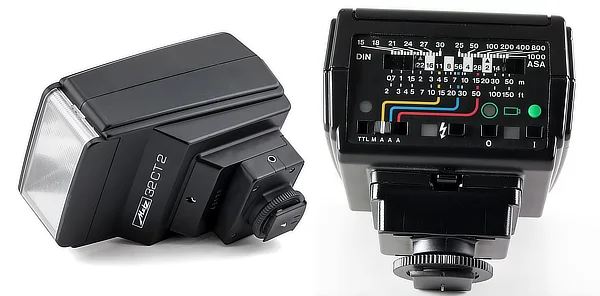
That was 20+ years ago. Cameras were subsequently developed with built–in TTL circuitry to accurately control the flash from within the camera. Neat! There were several caveats though:
- Each manufacturer had proprietary TTL protocols (+ hotshoe pin arrangements), forcing you to buy separate OEM flashes for each of your camera brands — for me Sony, Hasselblad & Leica
- TTL = reflected exposure measurements, with all its subject colour/ contrast reflectance issues
- Some of the TTL flashes were huge — easily the size of the camera
- It became dangerous to use older flashes like my “32CT2”, due to their higher flash trigger voltages — potentially frying modern camera’s electronics whenever the flash went off (!)
Time to get a new flash. In 2017 I mainly used flash with Sony cameras, so I sidestepped the overpriced Sony models and instead got a compact Bolt–VC 310SMI. It has a GN 31 and worked well in TTL mode for all my Sony gear, that is until I got the (intentionally?) TTL–crippled α7RIV in 2019 🤬
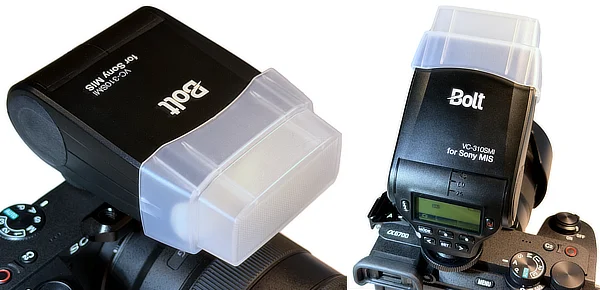
Luckily the “310SMI” works fine with my (retired) SLT-A77ii and new α6700, so I can still do TTL. It also can tilt upwards and rotate 90° to bounce light off walls or ceiling. Its protruding horizontal body design greatly reduces shadows cast by lenses. Like any flash its raw output is a pretty harsh, so I always use the supplied diffuser attachment. An undocumented feature is being able to internally recharge two Eneloop Pro AA batteries via its Micro–B USB port (!), despite the manual saying it was for firmware updates only.
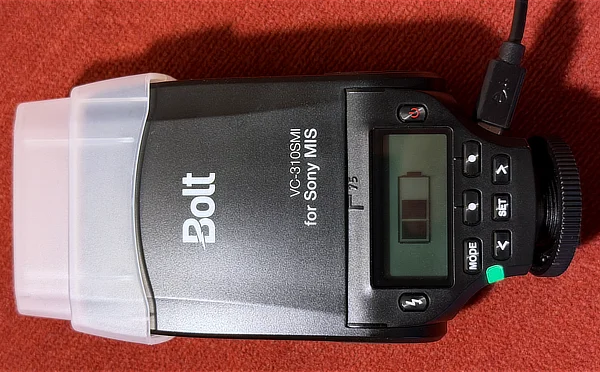
In 2024 I looked at the popular Godox V1Pro → for me too large & ungainly (+ fragile?) for an on–camera flash. In 2025 I looked at the Godox IT30Pro → much more compact, full TTL and built–in Godox 2.4GHz X wireless trigger. Unfortunately it’s a bit underpowered at GN 15 and you need an accessory “TR Hotshoe Riser” for tilt. Godox addressed this with their newer Godox IT32. Still a bit anaemic at GN 18, but looks promising. Since my more powerful “310SMI” (GN 31) continues to play nicely with the Sony α6700, will wait ‘n’ see if the new Godox TTL “iT32 & X5L” works properly with the Leica SL/ SL2.
Compact Manual Flashes ↑
The flash TTL vendor lock–in got everyone’s goat. It was (just) tolerable if you only used one camera brand or needed extended functionality. But for general use with all your gear?… Nup. There had to be a better way.
Fujifilm got the ball rolling in 2016 with the release of their compact Fuji EF–X20. Admittedly it was only GN 20, but in manual mode it worked with any camera. By using trial–and–chimp on digital cameras, you could quickly tweak the flash exposure to whatever you liked. A kludge, but it worked. Flashmeter people (ahem) did a single measurement and took the shot.
The EF–X20 was discontinued after a year apparently due to poor sales. Yet over time demand has increased so much it can now fetch ≈ $US 1K on the 2nd hand market. That and Tom Ford/ Terry Richardson direct flash has become a thing again.
Godox noticed and released their Godox iM30 (GN 15) to soak up the demand:
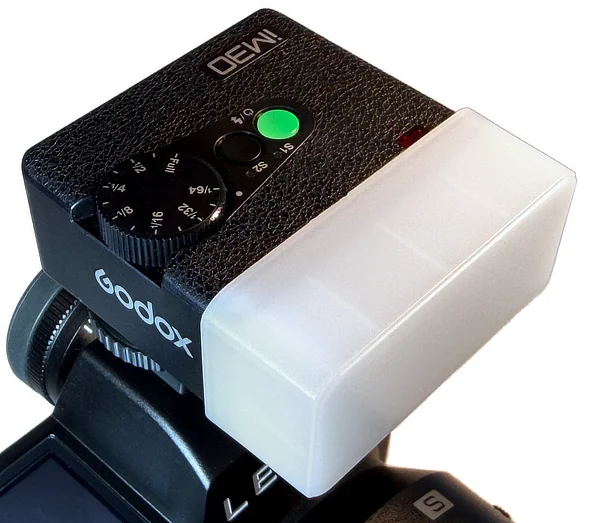
The iM30 is compact, surprisingly powerful and only requires 2× AAA batteries. Works with any camera since there is no TTL support (ie. manual output only). Alas it cannot tilt nor twist. I only use it at 1/64th power as a fill–flash for close to medium subjects, or as a catchlight to slave–trigger more powerful strobes. Similar to the Bolt 310SMI I recommend using it with a flash head diffuser (pictured), although unlike the Bolt you have to buy it as a separate “iM30–DF” accessory. My diffuser is actually an Moordiel generic thing, which I prefer as its translucent front panel is a bit farther from the strobe tube, yielding (slightly) softer light. I have also inserted a LEE 162 Bastard Amber gel behind the diffuser to warm the output to get nicer skin tones.
Metering Flash ↑
Monkeying around with strobes is a lot of fun, but to do it properly you need a hand–held incident flashmeter.
I learned this in the 1980s when working with film and manual flash. You never knew what you got until after the film was processed, so you had to nail it beforehand. How? Measure the flash output with a flashmeter and set the exposure accordingly. People who learned during the digital era tend to shoot in an iterative fashion until the exposure works. Which is fine, but also unprofessional when the sitter is waiting (im)patiently for you…
Thyristor and TTL controlled flashes made things easier, but the only way to do it reliably is by measuring the flash using an incident meter. No guesswork, reflectance or subject contrast issues. You directly measure the strobe light falling onto the subject and you’re done.
I have already written about my three flashmeters. Even if you baulk at their expense, use something. Don’t rely solely on camera or flash automation!
Continuous Light Sources? ↑
Time for another story:
In 1985 I did a couple shots of UNSW friend “RB” for her modelling portfolio. Her flatmate “L” was impressed and commissioned me to do her portrait in B&W. Not any ordinary head–shot though, but rather a copy of Greta Garbo in profile, taken by Clarence Sinclair-Bull to promote the movie
Susan Lenox (Her Fall & Rise).L wanted her portrait to be a close facsimile of the 1931 original. She even brought a bookmarked volume of Garbo Portraits to the shoot to make sure I stayed on task. You can probably guess L was formidable — 27, brilliant, confident, elegant, elusive, demanding and beautiful. I was a gobsmacked 21–year–old undergrad — who was I to say no?
The best way to recreate the 1930s feel was by using tungsten lights. Since I was part of the stage crew for the UNSW Law Revue, I borrowed for the shoot a 250W Strand Patt 23 spot, 500W Strand Patt 123 “baby” Fresnel and a 1000W Strand 6” Fresnelite with barn–doors. I also hired some lighting–stands from the Elizabethan Theatre Trust, bought a roll of dark grey paper backing and set it all up in my Hurstville unit garage. During the shoot L reclined almost horizontally on a chair, letting her shoulder length hair dangle behind. I moved in close with my RB67 on a tripod and metered the scene using incident readings from my Lunasix 3. We only did a couple of rolls — twenty 6×7 frames — and for a few of them stretched a black stocking over the 127mm lens for a soft focus effect. During the first few frames I said amusing things to put her at ease and make her smile & laugh, which she often did. But then she told me to shut up and added,
I don’t want smiling for this portrait, okay?I placed the 250W spot on the ground behind her and pointed it up for a rim–light effect. The Fresnels were in front, with the main 1000W to my right and the fill 500W on my left. I also had an angled silver reflector on the ground for shadows. I didn’t have a dimmer rack, so had to crudely rely on 1/R² to adjust the brightness by moving the lights back and forth. They were all plugged into the same 240V power board, yet the total 1.75KW was still within safe limits at ≈ 7.5A. It was seriously hot though, and we had to soon open the garage door for circulation. We also had to take regular breaks to cool off and dab sweat from L’s face. Despite the trio of intense lights, the slow 50 ISO B&W Pan F film at ƒ16 required long exposures, so L had to stay still and sometimes even hold her breath.
It was the first time I used continuous light for a photoshoot and it was a revelation. You could see immediately what the illumination and shadows were like. No more guesswork or hope or churning through packets of Polaroid instant prints or (worse) do a reshoot. Set up the light(s), measure the exposure, set the camera and… take the picture.
Small wonder a new generation of photographers overwhelmingly prefer continuous light, both in the studio and on location. It also dovetails nicely with video production — eg. the multitude of YouTubers and TikTokkers who use LED ring lights.
The tungsten–based rig I used in 1985 worked exceptionally well, but it was big and heavy and the heat it generated was something else. We were working with lights designed for overhead stage use, not at 1½ metres, and were both sweating like mad despite it being the last week of winter. I can imagine how tough things were for portrait photographers back in the 1930s, with their massive studio Fresnels and carbon arc lamps. Towel anyone?
Thankfully heat is no longer an issue with modern LEDs. Output intensity is however. Aside from multimillion dollar film–sets, a decent flash monohead will output far more light than any consumer LED, although the latter are catching up. Yet dim output isn’t much of an issue anymore as most people shoot at ƒ2.8 or wider at 1600 ISO. But if you want to stop down to ƒ11 at 100 ISO, then you gotta crank up the photons and current (affordable!) LEDs cannot. This is where flash still rules.
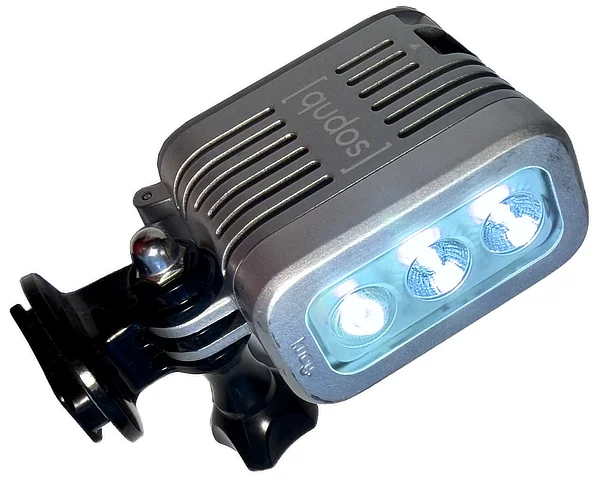
Nevertheless I have a cheap and small Knog Qudos Action LED lamp bought years ago for quickie use — eg. as shadow–fill for the equipment shots in this article. It has a puny battery but the entire thing is so tiny it is easy to always have in your bag. Wouldn’t use it to illuminate a ballroom, but as fill for a face or small object, why not?
What about reflectors to tame shadows? Use ‘em all the time, especially outdoors when camera flash sync is too slow for bright sunlight. For decades I used homespun things like crumpled aluminium foil or gold mylar stuck onto cardboard. I currently keep a tiny umbrella in my Sputnik
trolley because it unfolds to a large concave silvered surface. You can also get reflectors now which fold away into small portable sizes, eg. the XLite 105cm folding reflector kit. If you can live without the supports, the reflectors alone cost less than half.
So what happened to L’s portrait?…
A few days later we met again in the art deco lounge room of RB’s flat in Bellevue Hill. I brought a couple of contact print sheets and L thoroughly examined each 6×7 cm image with a large magnifying glass. RB was astounded by the results and said half–jokingly she was jealous. L was more circumspect. Out of twenty frames she selected only one, and marked it with a neat black cross in its bottom right corner. I encouraged her to choose a couple of alternatives, but was overruled.
She then gave me detailed instructions on how to print the image. I was to crop it into a square ratio and print it at a 45° angle, since she intended to have it mounted as a diamond shape to suit the art deco theme she was after. She emphasised she wanted to avoid anything conventional. I warned her the print wouldn’t be very large, maybe only 8×8 inches, but she said it was fine as 1920s prints she’d seen weren’t huge either. I was to supply the completed print and she would look after the mounting and framing.
Then came the awkward part — she insisted I also hand over the negatives once the print was done. I baulked, it would be like a composer handing over their only copy of the score! She calmly responded with a number of reasons, some sensible (another photographer had dudded her in the past) some paranoid (she was worried I would sell prints without her permission) and some based on Attractive Young Woman Privilege (it was what she wanted and that’s that). She looked me in the eye with an imploring expression, grabbed my hand and… I caved. She gave a subdued smile, which stabbed at my heart, and promised $100 on top of my fee. The following week when I handed everything over she paid in full and seemed pleased.
A month later a cocktail party was held to celebrate the unveiling of her new portrait. I was (belatedly) invited and the tiny apartment was filled with her top–tier associates. Her teak–framed photo hung as a diamond on the wall, harmoniously blending with the art deco surroundings. Her guests emitted
Oohs!andAahs!andI have to get one just like it!as they drifted past and delicately sipped their champagne. I became embarrassed. After a while L, dressed impeccably in a dark satin suit with cream silk blouse, asked for silence and gave an informal speech about the portrait and how much Garbo meant to her. She spoke softly and at length, but omitted to mention the bloke up the back who made it all happen. The guy who trekked across Sydney without a driver’s license to arrange the lighting, then took and processed the photo and sweated in a red–lit darkroom while he dodged & burned & selectively developed lighter portions of the Ilford Galerie print, by rubbing his bare fingers all over her face’s image while it was still immersed in the developer tray. Nor did she mention him inhaling concentrated selenium toner fumes, nor the hours of meticulous print washing & drying nor the entire evening he spent obsessively spotting and highlighting the dried print with archival retouching dyes.People sighed. People laughed. I left when she finished. What could have been a small early triumph instead became a lifelong object lesson in what to never do again [ Note IV ].
Copyright — All Rights Reserved ↑
Unless noted otherwise, everything in this article is and remains the sole copyright of its Australian author.
Although you are permitted to view this material online, no other use, reproduction or implied license is allowed without the author's prior written consent.
The internet may still be free, but intellectual property is not.
Notes ↑
By way of comparison, the Nikon F2 & F3 X–sync at 1/80th, a slight improvement over the 1/60th for the Nikon F. My “modern” M6 TTL syncs at 1/50th although the Nikon F4 and Leica R9 are both at 1/250th. The 50MP Sony α1ii can sync at 1/400th, yet Hasselblad, Mamiya and other leaf lens cameras achieved 1/500th in the 1960s. They are all blown away by the 2024 global–shutter 24MP Sony α9III which can sync at 1/80 000th → [return]
- Land, E. (1977)
The Retinex Theory of Color Vision
Scientific American (PDF) → [return] - Yes I am aware the ECN–2 process Kodak Vision 3 motion picture stock lacks an orange mask: eg. 50D, 250D, 200T, and 500T. Unfortunately it is 35mm only, although if you have nothing better to do you could roll your medium format film own via 65mm Type II perforated in Hasselblad 70mm cassettes in an “all–perf” modified A70 film back. All hypothetical anyway since Kodak cracked down on respooled motion picture film resale in Feb 2025 → [return]
- Discovered years later L owned full copyright to the image(s) as per the Australian Copyright Act (1968) as it was in 1985. We could have varied this by written agreement, but we didn’t. She never had rights to the physical negative, but I would have required her permission whenever I wished to reproduce the image(s) for a website or retrospective etc. See the Copyright Discussion in my “NSW Photographer’s Rights” article elsewhere on this website. BTW not sorting out copyright/ ownership remains a common problem even today → [return]
- Bought my Sigma AML72–01 magnification filter for $AUD 14 from BHPhoto online. You can also get it from Target USA for $US 18. Sigma Australia lists it for $AUD 208. Make of that what you will → [return]
Original Version February 2026 — all rights reserved